
Dublin school tax increase draws opposition
Resident tells board that district’s financial troubles are “systemic” and not a “one-time glitch.”

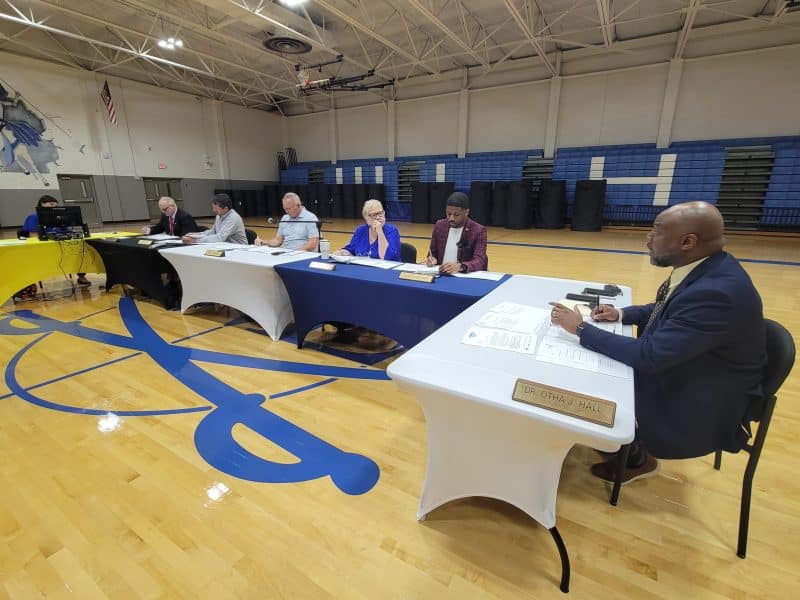
Doug Eaves, a longtime county government consultant, tells the Dublin school board that its financial troubles are “systemic” and not some “one-time glitch”/RODNEY MANLEY
Dublin property owners urged the City Board of Education on Friday to roll back its proposed millage rate to avoid a tax increase.
“Your issues are systemic. Your issues are not a one-time financial glitch,” Doug Eaves, a longtime county consultant and former county manager, told the board at the first of three public hearings on the tax increase.
The school district is mired in a financial crisis, with state officials having projected a $13.4 million deficit by fiscal year’s end before the system began cuts to staff and programs. By keeping the millage rate at 18.564 mills, the board expects growth in the city tax digest will generate an additional $558,032 (but that’s only if every taxpayer pays and does not account for a 2.5 percent collection fee charged by the city).
Eaves said the extra revenue would amount to little more than a “Band-Aid or a little pocket change.” He said the district’s recent money troubles are rooted in its agreement with the state in 2006 to become a charter system, which allows to school to exempt certain requirements and offer programs that others might not.
“I think that flexibility might have gotten mismanaged and abused, and allowed you to expand and come to this place. Now you’re having to pay the piper and fund those expansions beyond what your capabilities actually are,” Eaves said.
The schools operated in a deficit for a decade, from 2010 to 2020, and climbed out of the red in 2021. The recently finished 2022 audit – the most recent completed by the district – showed a $5 million surplus thanks to COVID funds.
“You’re faced with two choices – either consolidate or zero-base your budget to what you need rather than what you want,” Eaves said. “If you don’t want to consolidate, you’re going to really have to look at your programs.”
Don Dailey, a former city school board member, urged board members to roll back the millage rate as a gesture of goodwill toward constituents.
“There’s got to be some good faith come from y’all somewhere,” Dailey said.
“Don’t do this to the taxpayers again. Y’all had the ability to not go that high. Y’all owe this to the city. Y’all are taxing the citizens and the businesses to death.”
Other residents spoke against the increase, noting it comes after a 25 percent increase a year ago.
That increase came after property values skyrocketed with the first countywide revaluation in seven years. The board rolled back its millage rate last year, but the growth in the tax digest was estimated to generate about $3 million in new revenue.
“I would like to know a breakdown of where all that money went,” said one resident.
Unlike last year’s, the 3 percent growth in the new tax digest is “a normal revaluation increase,” board member James Lanier said.
“If that had been going on for the last 10 years, we might not be in this situation and you would not have seen that big increase last year,” Lanier said. “Property values are over-inflated here. I’m sure some of these would love to sell their homes at that value.”
Chairman Kenny Walters noted at the end of Friday’s meeting that the school board has two new local tax exemptions, including an expanded homestead exemption for seniors, that were approved by voters earlier this month.
The next two public hearings on Monday, Nov. 24, at noon and 6 p.m.
Board member Peggy Johnson said during member comments that cuts are being made according to “the best interest of our students,”
“Regardless of what’s being said in the community, we are looking at every area in our schools and cuts have occurred across the board,” she said.
The school board also acted on several agenda items after closing the public. Following a closed session, members approved a memorandum of understanding “for three funded positions.”
The board eliminated 51 jobs and implemented a hiring freeze as part of its deficit reduction plan filed with the state, but these positions, which were not specified, apparently will be paid for privately.
“We had an anonymous donor,” Walters said after the meeting.
The board also approved an interim superintendent’s contract for Marcee Pool, who has stepped into the role after former Superintendent Fred Williams stepped down to take an early retirement. Pool has earned praise from board members and state officials for her efforts in helping navigate the financial crisis.
Walters said the contract is for the remainder of the school term. Pool said the terms include a $10,000 supplement, and she also will have 10 days cut from her schedule restored.
With the supplement, Pool will earn about $130,000 this year. Williams earned almost $300,000.
“We got a bargain,” Walters said. “We’re saving a lot.”
Dublin property owners are likely facing another increase in school taxes, though not nearly as large as last year’s.
The cash-strapped Dublin City Board of Education voted Monday to keep its millage rate at 18.564 mills, which due to growth in the city’s tax digest will net a 3.9 percent increase in property taxes. The increase would follow an almost 25 percent tax hike a year ago.
That increase yielded almost $3 million more in property taxes than budgeted, yet the system still finished the fiscal year in the red and, according to state officials, faced a projected $13.4 million deficit before it began massive cuts last month. The increase this year is expected to bring in an additional $558,032.
The board must hold three required public hearings before approving the tax increase. The hearings will be held at noon on Friday, Nov. 14, and noon and 6 p.m. on Thursday, Nov. 20, followed by a vote at a 6:30 board meeting. Members initially proposed holding the two final hearings and the meeting on Friday, Nov. 21.
“I think Friday is a terrible idea if you want to give people the opportunity to come speak,” said board member Regina McRae.
The city tax digest increased in value to $799.8 million, up from $769.8 million a year ago.
“That’s due to any kind of new development, new properties, reassessment values,” said financial consultant Samantha Jenkins.
The millage rate should generate about $14.8 million in revenue – excluding any collection fees and taxes that go unpaid, Jenkins told the board.
“It’s an increase due to reassessment values. The value of homes have increased which means your revenue will increase,” she said.
“Good luck getting people to believe that,” said board member James Lanier.
To avoid a tax increase, the board would have to roll the millage rate back to 17.9 mills.
According to the schools, the proposed tax increase for a home with a fair market value of $150,000 is $38.04.
Author

Related Articles

Robotic showcase shows how surgeons help more patients through technology
Doctors and members of the community get the chance to move robotic arms that are normally used for surgeries.
School boards vote to extend bonuses to all staff
The Laurens County Board of Education has approved bonuses for all of its employees, to be paid on Friday.

Farmers Market opening Saturday
Farmers Market is about to open back for another year.