
Official summons: Emerald City Football ramps up referee recruiting push
Dublin’s Emerald City Football Officials Association is renewing its efforts to add some fresh talent to the local ranks of high school football referees, in hopes of reversing a recent downward trend in numbers.

Have a few hours free weekday evenings in the fall? Do you find black and white stripes fashionable? Can you blow a whistle?
If so, the local Emerald City Football Officials Association is interested in making you a part of its team.
The organization, responsible for adjudicating most middle and high school football games over a several-county area each season, is actively seeking recruits to join its ranks as soon as this fall.
New president Tanner Lords is renewing a yearly push to interest new folks in joining the ECFOA’s army of referees, which – in line with a national and statewide trend – has seen a recent decline in the number of fresh faces coming on board with passing seasons.
It, like many others across the Georgia High School Association and National Federation of High Schools, is working to tackle the issues that underlie patterns of dwindling involvement, as well as tendencies toward hesitation in potential prospects, in an exciting and rewarding sideline that’s as easy as ever to get started in.
“I think people are just maybe intimidated by it,” Lords said. “And I don’t think they should be.”
An NFHS survey conducted in 2022 estimated that high school athletics, across all sports nationwide, had lost a total of 50,000 or more officials in only the two and a half years since the COVID-19 pandemic began in 2020.
Another study by researchers with the University of Virginia, and published in The Sport Journal this past February, also found 56 to be the median age of high school football officials, pointing to a similar reality that the sport’s population of zebras is aging out much faster than it can be replenished.

Reasons are complex, and subject to a lot of debate, though consensus among experts is that an already downward trend in numbers, compounded by pressures of the pandemic, has placed high school athletics at a juncture where need for solutions to the problem is critical for its future.
Locally, Emerald City has felt the same type of crunch when it comes to building back its ranks as officials, for various reasons, hang up their hats and whistles.
While its core of long-serving refs has remained healthy and stable, recruiting and retaining new conscripts has been a struggle, and left the association lacking for much depth as it works to cover nearly the same amount of territory it has through the years, with a network of area schools scattered across Laurens, Johnson, Treutlen, Washington, Wheeler and other nearby counties.
Lords, in his 14th season calling games through ECFOA (primarily as a line judge/linesman) has become one of the association’s most experienced veterans since picking up officiating during college in 2011.
The Dublin High School alum – a lineman and linebacker for the Irish in his playing days – got his start with the hometown association, and has never left.
“I started when I was 18,” he said. “It just worked out. I was in college and I needed a job and I didn’t want to work in a bar or something like that, so I found this.”

Back when he began, ECFOA’s membership was pushing about 60 officials, and typically five crews strong on a given Friday night.
“We were very well-equipped for the area,” Lords said. “We didn’t ever have a huge organization, but we were able to fill our games and rotate officials pretty well.”
In the years to follow, there were some slight dips in numbers, though the most significant dropoff was from 2019 to 2020. The sudden exodus of retirees, or those close enough to decide against a return, affected associations statewide, though smaller, more rural ones were the hardest hit.
“It’s been very difficult to recover,” Lords said.
For most the size of the Dublin-based coalition, a workaround during the regular season has been reducing the size of crews to five on-field (plus an additional two as game and play-clock operators) from the standard six.
But even when going skeletal, current numbers still only allow ECFOA to field three varsity-strength crews on a given Friday night. So when a local schedule is particularly heavy on home games – and another association’s crew from out-of-town can’t be secured to step in – many schools are asked to play games on Thursday nights.
The switcheroo, while inconvenient enough for programs affected, can also have a ripple effect on junior varsity games scheduled for the same nights, which often have to be cancelled due to those conflicts, depriving younger players of the valuable developmental experience.
GHSA playoff crews, compiled by district, run with seven on-field members (just one shy of the eight making up college and NFL officiating teams) who are required to meet some slightly higher training and certification requirements that thin the pool of available bodies despite a more doable number of postseason games.
That’s why, each year since 2020, the GHSA has also pushed a portion of matchups in rotating classifications to Saturday during the first round of the tournament.
The stretch, for both local associations and the statewide committee overseeing the playoffs, has created plenty of challenges in making do that will only continue and increase if recruitment doesn’t trend back in the right direction.
“The good news is, that means there’s a lot of opportunity,” Lords said. “Right now’s a great time to enter the officiating workforce. You’ve got opportunity to call as much as you want, make as much as you want money-wise, because there’s a lot of opportunity right now.”
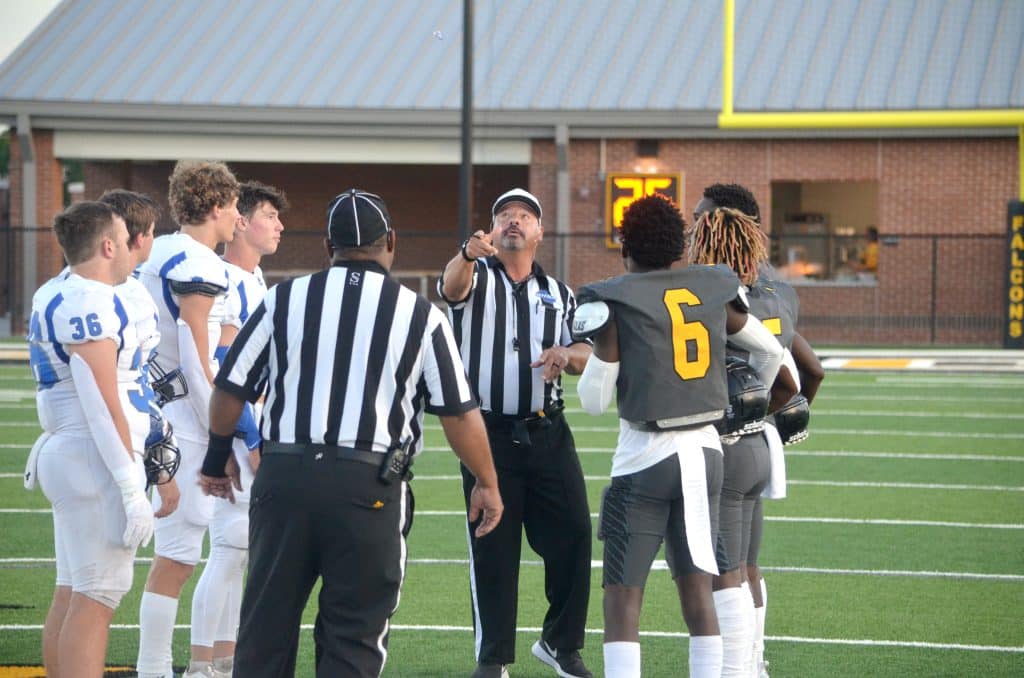
On a given week, ECFOA covers an average of 25 games, starting Wednesday nights with middle school action, then JV games on Thursdays, which both call for crews of 3-4 members. Varsity games follow on Fridays, with the occasional Thursday and Saturday thrown in due to scheduling, or weather-related postponements.
The pay is pretty attractive, and it only keeps getting better each year.
The GHSA’s new fee chart for 2024 sets rates of $120 per official for a varsity game, and $70 for each sub-varsity game. Postseason pay, if you’re selected to a playoff crew and advance in the competitive evaluation process, is a touch better, and also includes travel reimbursement.
Besides having an interest in the profession, and some initiative to learn and improve, the required buy-in to get started officiating football is at an all-time low. Plus, there’s now a solution for virtually every one of the most common hangups among those torn about giving it a shot.
Topping the list is concerns about having to cut out of work in time to make early kickoffs, which have been mostly eliminated in an era where the majority of games are played in stadiums with lights.
Games, now overwhelmingly favoring starts at 5:30 p.m. or later, give those with a standard 8-5 workday plenty of time to wrap things up at the office and get to the venue.
Another common excuse: I’m not in good enough shape.
Lords, who in his 30s and hits the gym pretty regularly, is definitely among the fittest of ECFOA’s bunch, though the general athletic profile of its roster is much more average in comparison, with membership across the board in levels of fitness.
Anyone who’s generally mobile can make it just fine. And the organization, with many current members in their 60s, has seen at least one in recent years officiate into his 70s.
“I would recommend being able to jog a little bit, but I don’t think you have to be a track star or marathon runner,” Lords said. “The mechanics of where to stand and what to do ensure that anyone can do it.”
ECFOA officials come from almost every line of work, with common day jobs ranging from law enforcement and insurance to law and education.
“We have got everything from medical doctors to janitors, and anywhere in between,” Lords said. “There’s not an ideal age. It’s never too late to start. It’s never too early to start… As long as you’re able, there’s no reason not to.”
The start-up cost – purchase of rulebooks, uniforms, whistles, flags and what not – is also now a non-issue. In the past, getting properly outfitted required shelling out several hundred dollars, though that cost has now been covered by a stipend courtesy of the Atlanta Falcons that’s been provided to local officials association for every new recruit.
“If you’re a first-year official, you get your fees, your uniform, all of that, paid for,” Lords said. “So getting into it, there’s no barrier to entry monetarily anymore.”

He’s found that the biggest objections for candidates mostly stem from the fear factor associated with pressure, potential criticism and a general lack of self-assurance.
The learning curve for football refs is one that looks pretty steep from the outside, until going through a training process that makes building your confidence on the field a simple and stress-free proposition.
Several ECFOA faithful – veteran ECFOA “white hat” Anthony Foston the head trainer – lead preseason preparations, then budget time weekly to coach, critique, evaluate and give feedback to officials, new and active, in-season.
Newcomers generally get plenty of experience calling middle school and JV games before they’re thrust into the fires of the real deal on Friday nights.
Though there is some leg work involved in getting up to speed on rules and techniques, there are no shortage of opportunities for preparation and practice.
“You’re not going to get out there and be unprepared,” Lords said. “You’re not going to get out there and not know where to stand, not know what to do. We prepare you. We take all the training and the guesswork out of it. So you’re going to be ready to hit the field your first game.”
And having a football background is by no means a prerequisite for officiating the sport. In fact, it’s quite the opposite, since former players or coaches usually have to overcome habits developed coming up in the sport that affect their ability to observe the game the correct way.
“You don’t have to have played football to be a great official,” Lords said. “Some of the best officials in our association, and statewide, didn’t play the game, didn’t play one snap of it… I humbly think that people who didn’t play are better officials.”
As time commitments go, officials are able to work as many, or as few games as their schedule allows. An hourlong weekly association meeting, taking place one of multiple nights, is all besides the games themselves that is required attendance.
Traditional 11-man padded football games are the bulk of the fall slate, but ECFOA also administrates the newer GHSA sport of flag football for area schools – Dodge County and WACO among them – who participate.
“It’s another opportunity to get some training if you don’t feel like varsity or sub varsity boys football is more your speed,” Lords said. “It is a lot of fun to call. It’s fast. It’s not as critical. But the girls still take it pretty seriously.”
The higher and further you go, the more intense the atmosphere of high-stakes games tends to be. When there are close calls, things can get a bit heated. But a certain amount of friction with fans and coaches simply comes with the territory, and is easily overcome when you have a supportive team around you.
Mistakes are inevitable, but they also provide great opportunities to learn and get better.
“You’re out there with your friends. You’re gonna have fun,” Lords said. “Nobody’s gonna be highly critical of you.”
Sound like something you’d like to give a shot, or at least look into?
Give Lords a call at (478) 290-7944, or buzz ECFOA secretary Joey Stinson at (478) 304-3127, to find out more.
Calling football, or officiating any high school sport, is almost universally a labor of love. Whether football’s a sport you enjoy following or not, there’s little about any part of the job that’s not an enjoyable and mentally stimulating experience.
“I love the game of football, and I didn’t get to play it as long as I wanted to,” Lords said. “Like everybody else, I had that childhood dream of playing forever, and I didn’t get to play it forever. This brings you as close as you can to reliving that feeling you got every Friday night when you played, or every Saturday when you played, whatever capacity you got to.”
He also contends that there’s nothing like the fellowship shared by members of an officiating crew working a game together any night of the week, nor the feeling of the big games – at small stadiums and large – you get to take in.
“We’re fortunate in the Middle Georgia area, we have some schools with some of the best atmospheres in the state,” Lords said. “When you’re on the field, and you’re getting ready for a big game, and it’s loud and the crowd’s there, there’s nothing like it. I wouldn’t trade that feeling for anything. It’s unreal.”
Author

Related Articles
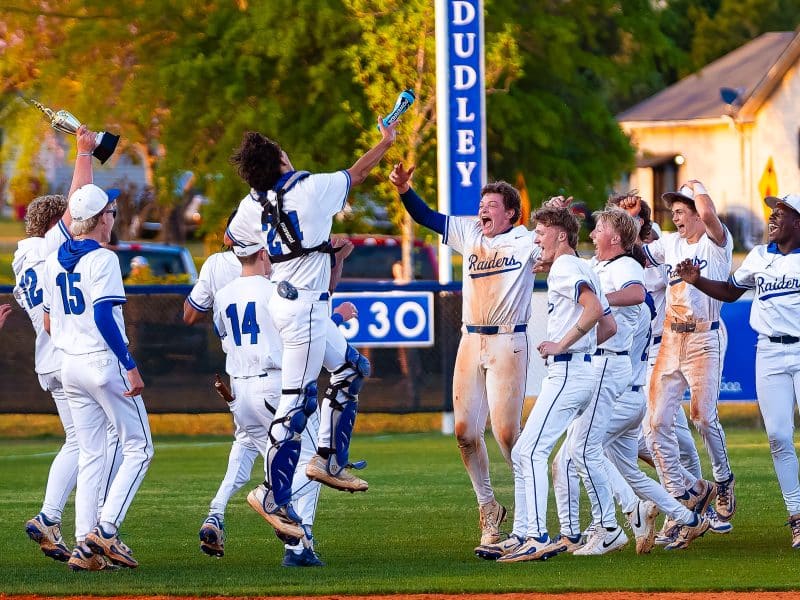
BASEBALL: West Laurens handles business vs. Harlem to clinch region 4-AAA title
The Raiders were well-prepared for their region championship moment, which arrived Thursday after 6-1 and 2-1 wins to complete a clinching sweep of the Bulldogs.

BASEBALL: Trinity takes care of Brentwood to complete sweep
The Crusaders secured the No. 2 spot in the region and maintained their top-4 state ranking with Thursday’s win to complete a sweep of the Eagles.
BASEBALL: Off of four-win week, East Laurens stuns WACO Tuesday for sixth in a row
The Falcons continued to show why they’re a team the region’s top contenders shouldn’t sleep on with their second big upset in a couple weeks’ time Tuesday night in Sandersville.