
Dublin school board cites ‘significant’ funding implications for tax law opt-out
Many education officials worry reform will be costly to schools
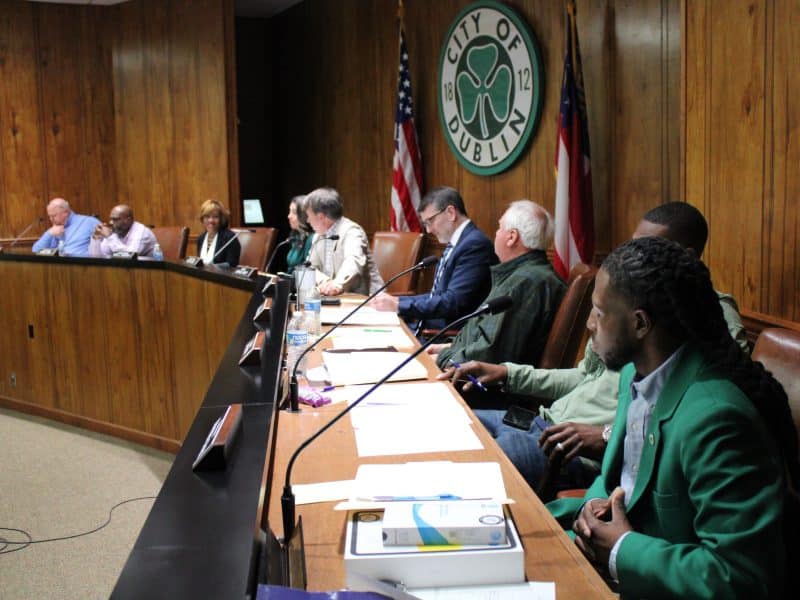
The Dublin City Schools and dozens of other systems around the state are opting out of House Bill 581, saying the new tax law’s “floating” homestead exemption could cost them millions in state and local funding.
“There are a lot of misconceptions and a lot of misunderstandings about what this bill does and does not do,” attorney Corey Kirby, who represents a number of school systems across the state, told the city Board of Education at its first regular meeting of the year Monday night.
Voters approved the tax reform in a constitutional amendment passed in November. It includes a new state floating homestead exemption that would limit the increase to a home’s taxable value to no more than the inflation rate that occurred over the prior year. The measure also allows for cities and counties to pass a local option sales tax (called a FLOST) to offset any revenue “lost” to the new exemption.
Kirby pointed out that the law makes no provisions for school systems to receive any revenue from the new sales tax, even though they stand to lose revenue.
“It’s important for you to understand you’re getting hit twice with this,” he told the board.
Local school systems pay what is called a “local fair share” to the state, which then distributes the funding to “poor” school systems through equalization grants. Because the state does not account for some industrial tax exemptions, it classifies the city’s tax digest as “wealthy,” the Dublin schools receive no equalization grant funding. However, the school board still has to pay the state 5 mills of the tax revenue generated from its property tax rate of 18.864 mills approved in October.
The floating homestead exemption would limit the value of a mill for the property owner but not necessarily for the state, meaning for the same 5 mills school systems could collect less revenue than they would be required to pay into the state.
“Ultimately it’s a reduction in state funds and a reduction in tax funds,” said schools Finance Director Chad McDaniel.
Board member James Lanier noted that the “fair share” money collected from supposed wealthy districts that do not qualify for equalization is sent to such systems as Gwinnett County, the state’s largest, and Houston County, which not only received more than $74 million in equalization funding last year, also collects a sales tax to help pay for salaries and operation expenses because of a grandfather clause in a law ending the tax.
“The city of Dublin, Twiggs County and Wilkinson County gets zero. Make that make sense to me,” Lanier said.
The law allows local governments and school boards to opt out of the exemption, but gives them just a three-month, one-time deadline to do so. Local governments and school boards have until March 1 of next year to complete the opt-out process. After the public hearings, governing bodies must pass a final resolution to opt out. Each hearing is to be advertised one week before.
Opting out also includes stringent requirements for publicizing the public hearings, including the purchase of specific-sized advertisements in the newspaper with specified language and the headline: “INTENT TO OPT OUT OF HOMESTEAD EXEMPTION.”
Kirby said his mother phoned him after seeing the ad in her local newspaper, concerned she was losing her existing homestead exemption.
“We’re not losing any exemptions that are in place,” he said.
The opt-out process also requires issuing an official news release stating the intention and reasons for opting out. The Dublin City Schools issued its official press release after Monday night’s meeting, which including the previously advertised dates for the hearing.
“The Dublin City Board of Education has announced its intent to opt out of the statewide adjusted base year ad valorem homestead exemption for the Dublin City School District. This decision has significant implications for the district’s ability to fund vital resources and programs, and the board is inviting all concerned citizens to engage in this critical conversation,” the system said in the release.
The three public hearings all will be held in the Dublin High auditorium. The first two will be held at 6 p.m. on Tuesday, Jan. 14 and Tuesday, Jan. 28, and the third will be at noon on Friday. Feb. 7.
Following the hearings, the board must adopt a resolution stating its intent to opt out.
Once a government or school board opts out, it cannot opt back in, although the measure allows local bodies to get local floating homestead exemption passed in the General Assembly. Several board members said they favored proposing a local exemption – that perhaps would include additional considerations for senior citizens – through its local delegation.
“We can say it’s up to our Legislature to pass it, and if it don’t pass, it ain’t us,” Lanier said.
Superintendent Fred Williams said the new state law’s impact will likely be felt several years from now.
“To be very clear, opting in or opting out does not change my legacy as a superintendent. If we don’t opt out, what about those behind me?” Williams asked.
Kirby said the impact will be “significant.”
“It may take five or seven years before you see this … at some point you’re going to have to raise the millage rate.”
“We’d have to raise as far up as we could go, 20 mills,” said board chairman John Bell.
The law aims to protect property owners from rapid rises in property values – and property taxes – like the ones Dublin and Laurens County homeowners saw that last year, resulted in school taxes increasing 25 percent in the city and 7 percent in the county. Critics contend the law takes control from local officials and instead gives it to the state.
The Dublin City Council and the Laurens County Board of Commissioners and Board of Education all have indicated they do not plan to opt out.
Author

Related Articles
Council OKs another round of water meter replacements
The city of Dublin begins a fourth round of installing water meters.

Trinity considering 3-day teaching model
Local school looking to see if there is interest in a three-day-a-week teaching model.

Storm damages Goodwill store
Heavy rain and 19 mph wind may have been the cause of the damage done to a store at the Dublin Mall.