
Dublin school board OKs new salary scale in hopes of balancing budget
Draft of new budget shows district spending $10 million less in fiscal year 2027.
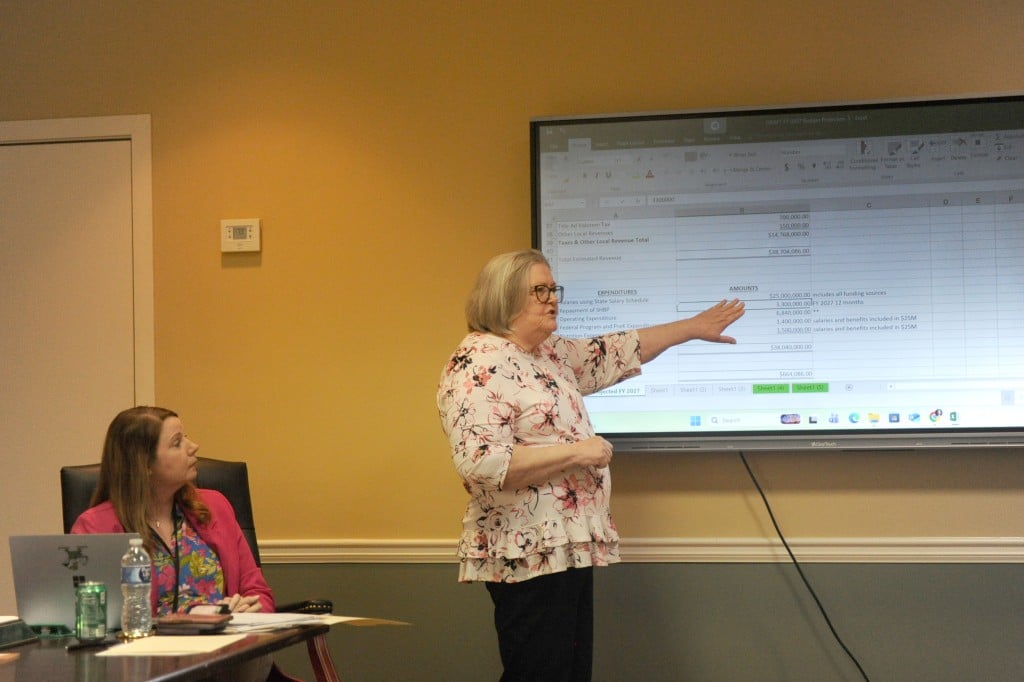
Interim Chief Financial Officer Betty Corbitt explains the draft of the 2027 budget to the large crowd at Monday’s meeting/RODNEY MANLEY
The Dublin City Board of Education adopted revised pay scales Monday night that officials say will give the cash-strapped district a balanced budget for fiscal year 2027.
The board also previewed a proposed $38 million budget that reflects a huge reduction in spending – about $10 million – from last year, with about $25 million earmarked for salaries. Under the plan, the system would end the FY27 with a $664,000 surplus.
Job and salary cuts are already paying off. Board member Jeff Davis noted that in October 2025, the school system was paying almost $2.8 million each month for salaries, but lowered that to $2.3 million when positions were eliminated. Projecting that out 12 months, Davis said, the system will save about $9.6 million annually.
“That’s how far out of whack we were,” Davis said.
The board approved a new salary schedule that adopts the state’s pay scale, and it also approved a supplement schedule that reduces pay and extra days for leadership positions.
“They were drastically reduced,” Corbitt said.
The highest supplement – for the head football coach position – now maxes out at $15,000 and additional days at 20. The board also reduced 240-day employees to 230 days. However, the plan now includes no furlough days for teachers.
A salary schedule approved last month included eight reduction, or furlough, days for teachers and staff, which in part led state officials to pull back extra help it had been providing the district.
The new budget also earmarks $3.3 million toward the district’s debt to the State Health Benefit Plan. The school system’s financial crisis first surfaced last August after the Georgia Department of Community Health alerted state education officials that Dublin City did not pay the health plan for the entirety of FY 2025 and also owed more that $5 million in past-due payments. Officials also found the district also owed $780,512 withheld from employees’ pay but not sent to the Department of Community Health.
State education officials later found other “operational deficiencies” that included the board not having completed an audit since 2021 and a projected $13.4 million deficit by June 30. Audits have since been completed for 2022 and 2023, showing a pattern of overspending – and delaying the insurance payments.
A special audit requested by local lawmakers confirmed the root causes of the crisis – overhiring and overpaying employees, wasteful spending and lax oversight – while also identifying specific concerns ranging from late tax payments to the IRS to “abnormally” high credit card spending and unwarranted travel and expenditures. The special audit also pointed to instances of family members traveling on out-of-town leadership retreats at the system’s expense and undocumented payments to a local florist.
That led Dublin Circuit District Attorney Harold McLendon to formally request the Georgia Bureau of Investigation conduct a criminal investigation in the district’s finances.
Board Chairwoman Amanda Smith said the district is working hard to reverse “years of mismanagement.”
“As everyone knows, based on audit findings, the last two financial officers hid from the board the true financial condition of our school district and instead provided the board with false information that we were on solid ground with regard to our finances,” Smith said. “In the four months I have served in a leadership role, there has been an expectation that these deeply rooted problems could be corrected immediately. That is not realistic and, more importantly, it is not responsible. We are focused on fixing these issues the right way – through accountability, structure and long-term solutions.”
The tentative budget is exactly that, especially considering the state is recommending Dublin City eliminate its Irish Gifted Academy, as well as Moore Street, an alternative school for grades 6-12.
Former school board member Regina McRae, one of about a half-dozen concerned citizens who addressed the board, questioned the drafting of a budget before the futures of IGA and Moore Street are decided.
“They put the cart before the horse because, to me, you could have had a better budget if you decide what programs you’re going to keep first,” McRae said after the meeting.
Following an executive session, the board approved a list of personnel moves that included the resignation of IGA principal Matt Taylor.
The new salary scales and proposed balanced budget certainly show significant progress, but will it be enough to get the district back in the state’s good graces? Last month, state Superintendent Richard Woods informed the district that he was withdrawing extra staff and support the state had been providing to help the system navigate the financial crisis. citing a “misalignment of priorities.” His decision came the day after the local board had approved a earlier version of supplements and salary schedules that state officials said did not cut costs enough.
By scrapping last month’s plan and switching to the state salary schedule, the district will save an additional $500,000, said interim Chief Financial Officer Betty Corbitt.
Smith and other board members expressed appreciation to the state for its help, but they also assigned some of the blame there, as well.
“It is clear that the full extent of these problems only became evident once there was direct involvement inside our system,” Smith said. “These conditions developed over time, and it is important to acknowledge that they were allowed to persist for years, even by the state.”
Longtime board member John Bell took exception to Woods informing the board by strongly worded letter that he was withdrawing the extra help.
“I was not happy at all about that letter. All they had to do was make a phone call, and we could have straightened that out right there,” Bell said.
Smith also provided an update on the GBI’s investigation for the large crowd attending Monday’s meeting. “I am aware that they continue to request information and are actively completing their work. As soon as any official information is provided to me, I will ensure that it is communicated appropriately.”
The salary schedule was approved unanimously, while the supplement scale passed 6-1, with JoAnna Glover voting no.
“I don’t think that it’s fair. It’s too high,” Glover said later.
Several residents who spoke to the board encouraged it to embrace a proposed community task force to keep the public involved and informed. Several board members seemed receptive to the idea.
“If you have any ideas, we appreciate it,” said board member Kenny Walters. “We’ve had the chief of police down here, the sheriff’s been down here, the [district attorney] has been down here. We got the GBI down here now. If y’all can find out something they could not find out, please let us know.”
Several residents also urged the board to keep the public better informed.
“This is not a moment for quiet leadership,” said Alfred Wheeler. “This is a moment that requires boldness. This is a moment that requires transparency. This is a moment that requires accountability.”
The board held a budget workshop prior to Monday evening’s meeting. During both, Corbitt provided detailed breakdowns on the tentative budget and the salary and supplement scales. Supplements, she said, were “reduced drastically.”
Corbitt also pointed out that the state salary schedule often underfunds positions. For example, the state salary schedule funds just one school nurse for the district at $57,000.
“That does not fund one nurse,” Corbitt said. “They never fully fund anything. … They’re just giving you a percentage.”
Salary costs, as with every school system, is by far the budget’s largest expenditure category. A large chunk of that goes to the State Health Benefit Plan, an at annual cost of $24,336 per employee.
“We pay more for benefits than salary for some employees,” Corbitt said.
A significant change will be the elimination of “Lucky Loot,” a one-time lump salary payment made to employees each January.
“There will never be another Lucky Loot. If I hear about Lucky Loot, I will come see you,” Corbitt joked.
Board member James Lanier, at his first meeting since having open heart surgery, said during the workshop that the proposed budget from Corbitt “was much better than we’ve ever been presented in the past.”
“Before it was a bunch of smoke and mirrors, and that’s what got us into this mess,” Lanier said.
Also Monday, the board voted to hire a permanent chief financial officer, Teresa Seeley, currently the controller for the Savannah-Chatham County Public School System. She is set to begin May 18.
Author

Related Articles
Alamo City Council Commits Resurfacing Payments Following Cyberattack
The Alamo City Council held a called meeting to discuss “potential litigation” on June 30 in the Alamo City Hall.

Lori’s Dive-In Defied the Odds to Bring Connection to Alamo
Lori Miller Purvis has experienced two consistent elements in her professional life: motion and connection.
Treutlen County Assessors Adjust Property Values to Comply with State Requirements
The Treutlen County Board of Assessors announced on June 18 the adjustment of property values in the county for the 2026 tax year in order to comply with the standards of the Georgia Department of Revenue (DOR).