
The Blue Monster, reborn: Timeless tradition at Johnson County football stadium gets new look
This offseason’s renovation of Herschel Walker Field, necessitated by storm damage from Hurricane Helene, features new sets of home and away grandstands and an expanded press box.
“Something old. Something new. Something borrowed. Something blue.”
The rhyme is a traditional guide for bridal accoutrements, and not necessarily football stadium construction, but Johnson County High School certainly checked all four of the boxes in its renovation of Herschel Walker Field at Lovett Stadium this offseason.
The new look of the Trojans’ historic home preserves many beloved aspects of its old-fashioned style, while modernizing others that were long overdue for an upgrade in a project that took a bit of inspiration from other recent stadium builds and rehabilitation projects nearby, and also emphasized the last point with as big a splash of their primary color as could be managed.
“We weren’t going to go with a different color,” said Johnson County head football coach Don Norton. “We were going to make it as blue as we possibly could.”
Admittedly, the stadium’s new metal grandstands aren’t able to carry as much of the signature shade as its former concrete ones, which could be painted in their entirety.
These larger prefabricated bleachers, though their benches, steps and walkways come only in the standard silvery color, are decked out with special blue aluminum planking in the forward-facing spaces between to give them a very similar appearance.
The design element was one of many steps taken out of respect for the unique character that’s made the venue an area high school football landmark.
“We tried to maintain as much tradition as possible,” said Charlie Lindsey, Johnson County Schools’ associate superintendent of technology, facilities, transportation and student information. “This is known as The Blue Monster, and the bleacher systems that were designed for us had that theme in mind… When you look at them, there’s a lot of blue. And we’re trying to maintain that theme throughout the stadium.”
Though nearing a 60-year milestone from its opening this coming fall, The Blue Monster was still in its prime going into the 2024 season last year.
Then came Hurricane Helene, whose winds got ahold of sheets of security canvas that were affixed to the back of seating areas, damaging portions of the concrete structures on either side as well as much of the stadium’s fencing, and displacing the Trojans from their home field for the rest of the fall.
JoCo would end up playing all its remaining home games on the road, and hosted two playoff contests at nearby East Laurens, as school officials pondered their options at a sort of crossroads between potential courses of action on the stadium’s future.
Because their damage assessment deemed both sets of antiquated grandstands more cost-effective to replace than repair, a full-scale remodel took preference over any sort of makeshift patchwork.
“We had little choice,” Lindsey said. “The visitors side was condemned, and then the existing home side bleachers were either going to be repaired or completely replaced… The board just made a decision to go ahead and take the opportunity to rebuild and get it up to standard.”
After demolition, things were able to move in a hurry, as the school finalized designs and contractors in time to begin work in February – well ahead of the typical multi-year timeline for a project of this scale.
“Normally, this probably would have taken a year and a half to two years of planning to get to a point of construction,” Lindsey said.
There was a bit of a rush to get the ball rolling soon enough to have the retooled stadium ready for the start of the 2025 season next month, but those involved in the decision-making process on plans were still careful to take their time to do things right, and do them well.
Norton recalls joining several of them on an all-day tour of various newer Georgia high school stadiums in the region to take notes on potential design elements.
“We had our superintendent, our assistant superintendent, athletic director, principal, and three board members drive on a school bus about an hour and a half to two hours away in the pouring rain and look at stadiums,” he said. “They cared enough to take the time and make a long ride, get wet, get dirty, do something that most people wouldn’t do…When they were there, the questions that they asked were what can we do better? All they wanted to know was how can we do it better and not take shortcuts. When I’m telling you the board of education, superintendent and community is committed to this place being nice, they’ve done it.”
Norton and Lindsey, all through the process, also put heads together with Jim Ledford, national sales manager for Wrightsville-based Electro-Mech Scoreboard company whose technology already has a significant presence in the stadium. His input, with particular attention to program tradition and the long-term future of the facility, was of great value.
“He’s been very influential with the look of this stadium, and some stuff that’s gone on,” Norton said. “I had a vision, and I basically gave it to him, and told him to run with it… He’s done it. He was very instrumental in the awesomeness of all that.”
Improving function and flow, finding fixes to existing flaws and making as many modern upgrades as practical were major priorities.
“In the short time we’ve had to get this together and stay within what we can afford, we really have tried to hit everything that we would want to have done if we’d had time to sit and plan for this three years down the road,” Lindsey said.
But honoring tradition – for a stadium whose game atmosphere is defined by pageantry, personality and pieces of the past shared by so much of the community – was also just as big a deal.
“In the southeast, football is just kind of special to everybody,” said Ledford, who’s a 1990 JCHS graduate. “But obviously, here in Johnson County, Lovett Stadium has just been a fixture in the community. I think all of us, since the first game was played there in 1965, everybody in the community has been to multiple football games, soccer games, graduations, different events. It just kind of holds a special place for everybody.”
Sadly, it was impossible to recapture many of the stadium’s nostalgic elements that date back to its construction, in particular the original bleachers and press box that – while outdated by decades – held a special place in giving the venue its small-town identity.
“It was one of those iconic stadiums,” Lindsey said. “We hated to lose that, but if we were ever going to modernize and make a change, this was it. From a financial standpoint, you hate to look at it in those terms, but for a small, single-A district with less than 1,000 kids, it was really important to maximize an opportunity.”
They did, however, make a goal of re-creating those things in a way that translated authentically to this new era.
“All of us who were involved with the decisions probably put tradition right up there with the most important things that we do,” Norton said. “The traditions of this program and of this community was paramount, and upholding those traditions was super, super important.”
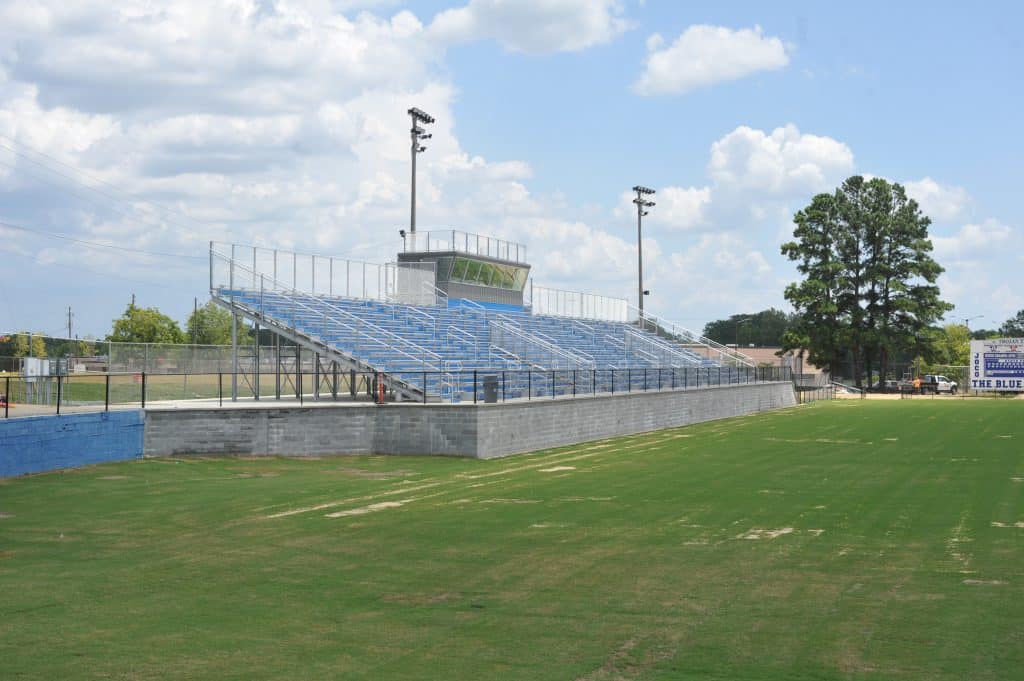
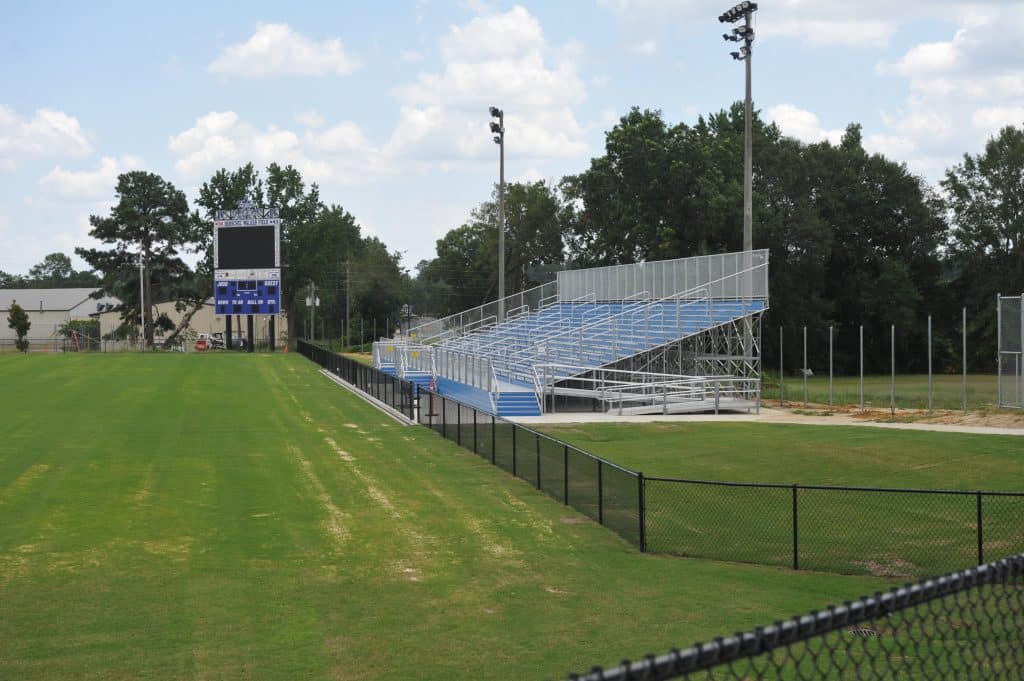
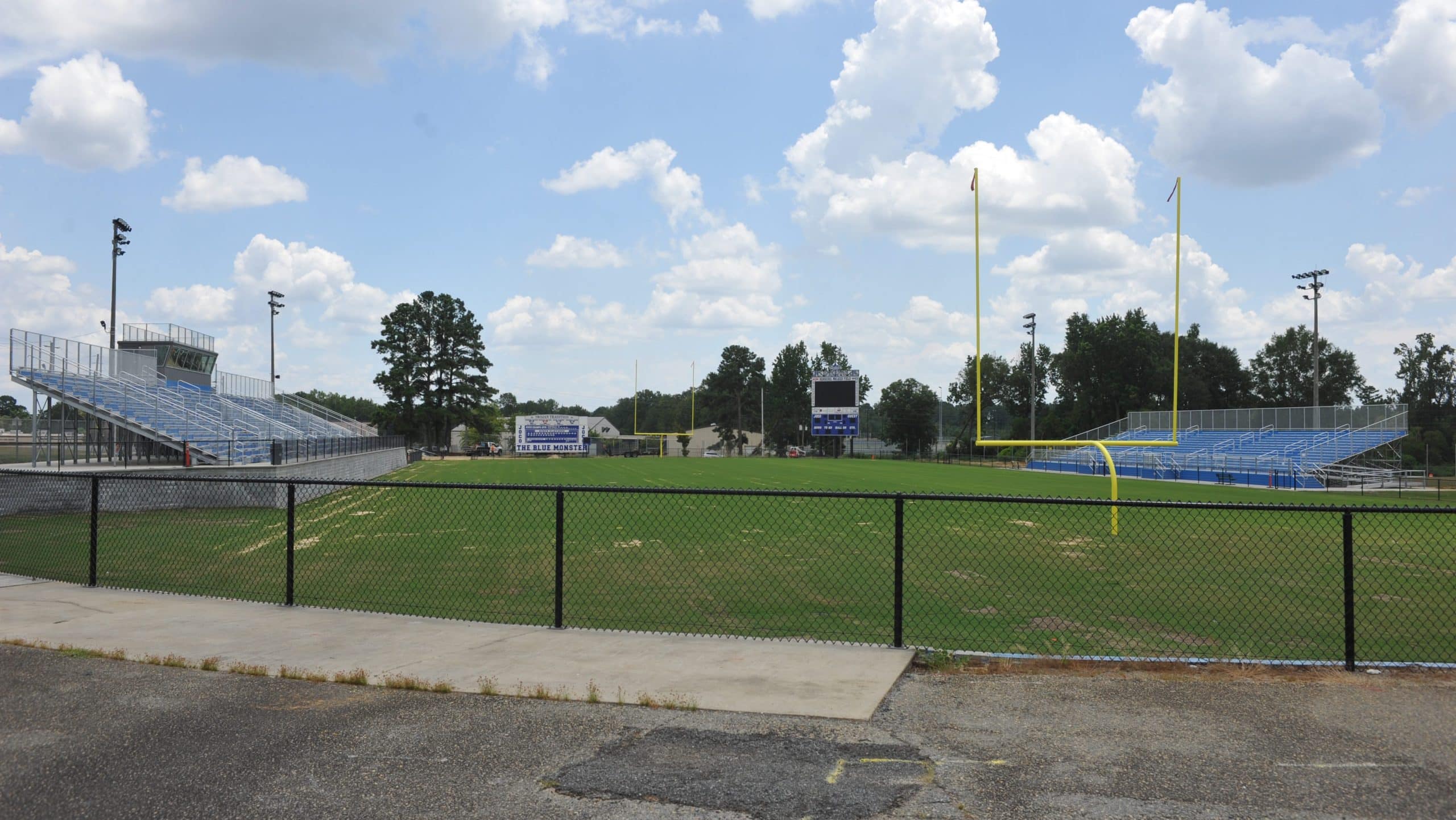
Besides their differences in makeup, what’s most noticeable about the new banks of bleachers is their comparative size.
On the home side, the seating array juts significantly closer to the edge of the playing field, utilizing space that made up an abnormally wide sideline buffer in the old layout. The grandstand, and its front walkway, are also now elevated a solid eight feet above field level to create a “pit” style of seating that extends the blue cinder block wall from the north end zone the entire length of the home section.
The revamped gallery will not only offer a higher vantage point for spectators, but also put them much closer to the action.
“We moved the fans toward the field, so that’s going to increase the experience of the noise, and everything else, and really put those fans right there on top of the play,” Lindsey said.
Atop is a new press box, with downward-facing window similar in design to those at East Laurens, that offers a larger working area – partitioned into five separate booths and topped with an open-air crow’s nest – for announcers, officials, coaches, media and other personnel.
“It’s much larger, probably three times larger than what we had,” Lindsey said.
The all-in-one structure will also supplant the more recently built mini-coaches box on the opposite side that was also demolished.
The opposing bank of seats is similarly larger and taller, though raised only slightly from the existing pathway that slopes down along the stadium’s natural topography.
Capacity-wise, both sets of seats – by generous measurement standards – will be able to accommodate an estimated 2,400 fans, in a major increase from the former capacity unofficially listed at right around the GHSA baseline of 2,000 required to host a state semifinal game.
The stadium’s original restroom, concession and visitor dressing room buildings remain, along with the original ticket booth structure at the entrance, though the visible marquee with lightbulbs spelling out “LOVETT STADIUM” in Broadway style – which was a good bit worse for the wear – is getting a much-needed restoration courtesy of Electro-Mech.
“Even though we’ve gone away from the bleachers and the stands, and that part of the look of the stadium is going to be completely different, the Lovett Stadium sign is the original one from the mid-60s,” Ledford said. “To my knowledge, Electro-Mech built that for the first game in 1965, and they’re keeping that. That was important for everybody from the start, to be able to hold onto that original piece of history.”
A handful of other updates may look new, though most were in fact made before the 2024 season when few got a chance to notice before things closed down after the storm.
The large “Trojan Tradition” board in the end zone has been freshened with letters identifying the stadium as Herschel Walker Field on the back, and some new front-facing signage around the perimeter, notably a large sign spelling out “THE BLUE MONSTER” below.
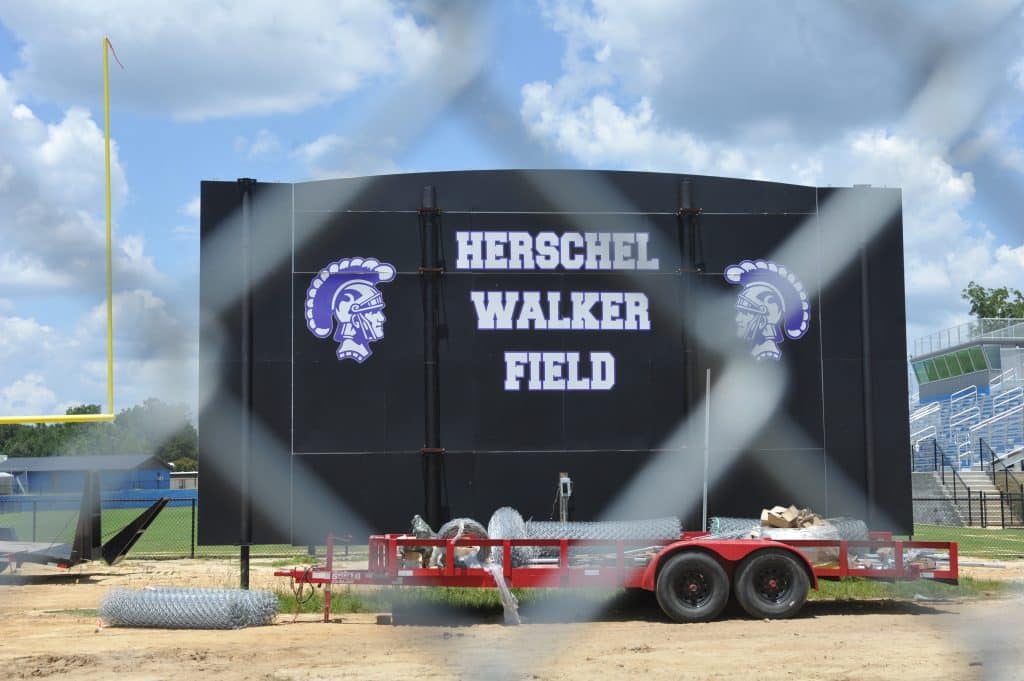
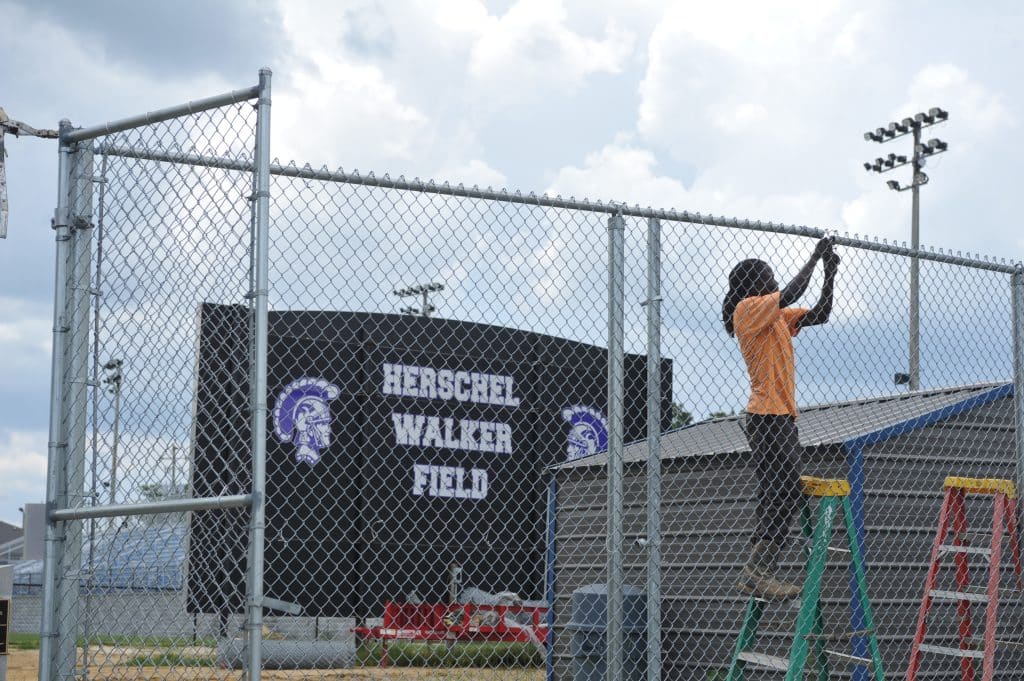
High fencing around the perimeter of the stadium and the low-rise chain link partitions bordering the field along the visitor side and south end zone are both being replaced, in a slightly retooled configuration intended to better accommodate the team’s entry to and exit from the field, as well as that of the emergency vehicles parked there whose alarms have become an integral part of touchdown celebrations.
“We changed the entry point onto the field at that end to better accommodate those vehicles, but yes, we’re definitely going to have the fire truck,” Lindsey said. “We’ve gotta blow a siren every now and then.”
He and Trojan fans hope to hear it as often as possible this fall. How much they do will be up to Norton and his team.
“It’s all on Don,” Lindsey said with a laugh.
They’ll have ample opportunity to break in the new-look stadium this fall, as JoCo’s schedule – thanks to the return of those three region home games they traded out by necessity last year – guarantees a total of 10 home games… twice for scrimmages and eight out of 10 weeks in the regular season. And that doesn’t even account for the likely opportunity to host one or more state playoff games, which have been a certainty throughout a run of three-straight region championships the Trojans are hopeful to continue this year.
The handful of workers on-site were down mostly to finishing touches as they worked on fencing installation, and some wiring at the base of the new press box, upon a visit Monday afternoon.
But the stadium is more than on schedule to be ready for action next Friday as JoCo opens its preseason in a first of back-to-back scrimmages against Wilcox County (the other will come the following week against Jenkins County). The August homestand continues as the Troajns open the regular season with their traditional “Border War” vs. East Laurens Aug. 15.
“We’re working just as hard as we can to get it finished,” Lindsey said.
There’s no question things won’t be quite the same in this new era for Wrightsville natives with vivid memories of the stadium, and a deep affection for those tradition-rich chunks of blue concrete that, while humble and unsophisticated, were as much witnesses of six decades of Johnson County football history as the folks who sat on top of them.
“It’s a little saddening that we’ve had to go away from that because of the storm, and go away from that old-school look and feel,” Ledford said. “But the new stadium, in general, the updated aesthetics of it, are great.”
But a school and football program is not made of the material comprising its stadium, rather the players, coaches and fans it houses on Friday nights.
Norton is confident that the passion, loyalty and heritage that make Herschel Walker Field the atmosphere that it is will live on, as members of the Trojan nation make some new memories in what will now remain a great place to play and enjoy high school football for many years to come.
“We nicknamed it 25 years ago or so,” Norton said. “And it’s kind of taken on its own little life. We’re very excited and very proud, and I tell folks all the time, there’s no duck tape, zip ties and no band aids out there. They’ve done it right.”
Author

Related Articles

BASEBALL: Bleckley County makes best of two big innings in sweep of Dublin
The Irish stumbled hard over a colossal inning in both games that lifted the Royals to wins last Tuesday and Thursday, as their recent dry spell lingered on a week longer.
BASEBALL: Close ones with WACO, Hawkinsville start off three-game drought for East Laurens
A couple winnable ones got away from the Falcons last week as a late rally fell short at Hawkinsville, and a chance to sweep Washington County just slipped through their talons.

SOCCER ROUNDUP: Dublin, East Laurens can’t shake hard luck; Win streaks resume for Trinity girls, West Laurens boys
The Irish and Falcons ran into some buzzsaw games in last week’s region action on the road, while the Raider boys and Lady Crusaders got back to their winning work in the last local matches before spring break.