
Shoe reboot helps Dublin special teamer reclaim dying art of straight-on kicking
The Irish recently teamed up with a Macon cobbler on a last-ditch project to restore an irreplaceable square-toed kicking shoe that will equip their Nazyon Mitchell to continue one of football’s lost kicking customs this season.
The sure sign of a lost art is that tools of the trade either no longer exist, or have become next to impossible to find.
That can definitely be said about football’s vanishing custom of straight-on kicking, and the square-toed shoes used to do it that are quickly going the way of compact discs, phone books, Pontiacs and typewriters.
At one point in the not-too-distant past, you might have been able to say they don’t make them like they used to.
But now, they’ve stopped making them altogether.
That fact was a discovery equal parts frustrating and astonishing for Dublin head football coach Roger Holmes earlier this summer as he sought to potentially replace the team’s threadbare kicking boot that had suffered a recent blowout.
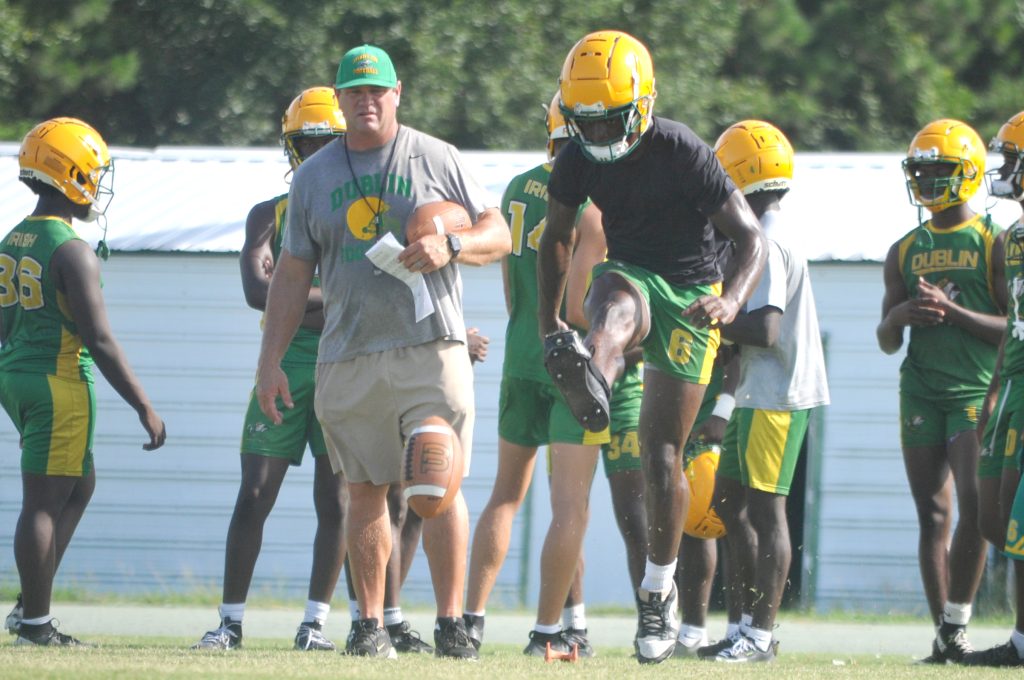
Efforts to track down another one on the world wide web, or by asking around, were fruitless, uncovering probably more fellow coaches and athletes interested in buying one than units of the specialized footwear that manufacturers have long since discontinued.
And antiquated sporting goods, unfortunately, aren’t things you typically stumble across browsing a thrift store.
“You just can’t find them,” Holmes said.
Luckily for the Irish, a creative solution to the puzzle wasn’t too far away.
And thanks to the help of a Macon-based shoe repairman who not only mended but completely refurbished the busted boot, they’re now set for the upcoming season, and hopefully beyond.
But Dublin’s 25th-year head coach, whose football lifetime has seen numerous eras of the game and its evolution, was a touch fascinated when hit by the realization that a historic convention of special teams was not simply going out of fashion, but on the verge of complete disappearance.
Though critically endangered, this species of placekicker that approaches the ball from directly behind, rather than at the offset angle that do their soccer-style counterparts, is not yet extinct.
The technique still has its adopters, but they are now exclusive to the high school level where at least a few players here and there still find that it works better for them.
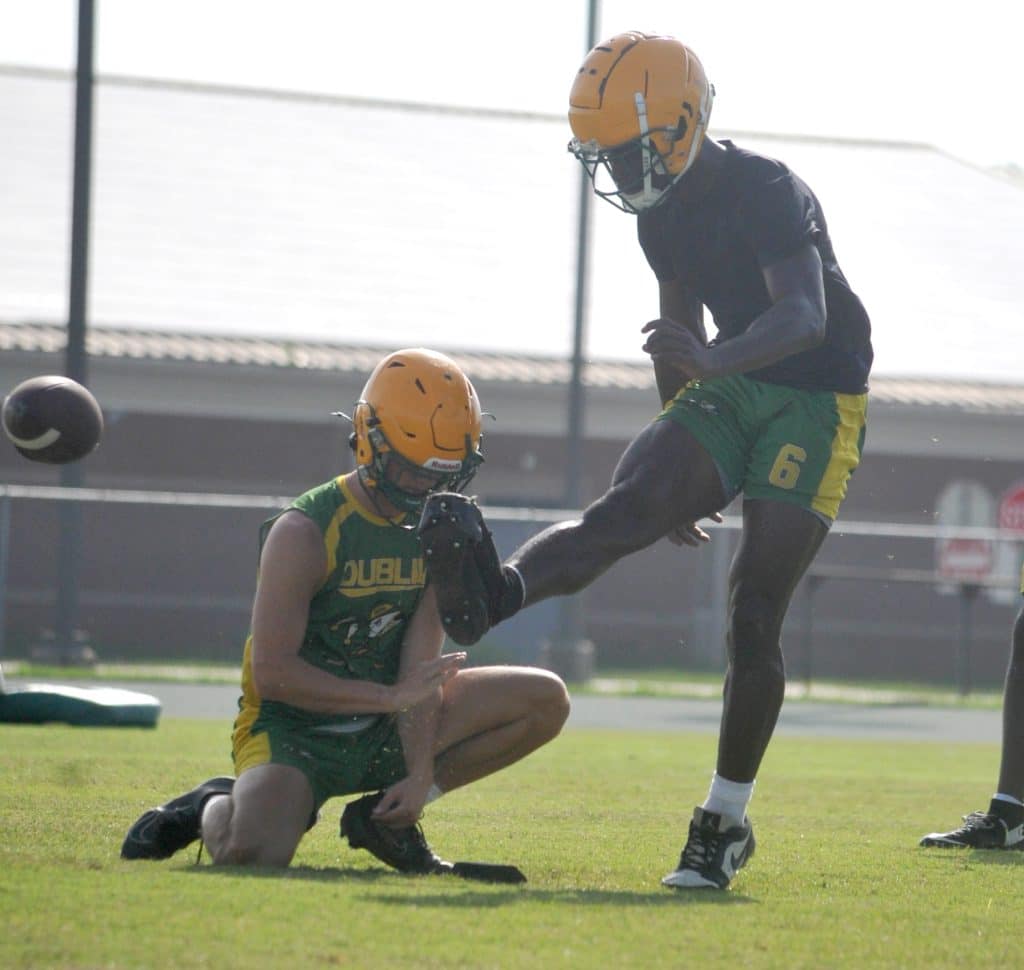
One of those is Irish senior Nazyon Mitchell, who came to prefer the old-fashioned mechanics when he began handling kickoffs for his team midway through last season.
“Straight-on kicking, I feel more aggressive,” he said. “Soccer-style, you’ve gotta be more fluid. I’m not a flexible person like soccer-style kickers.”
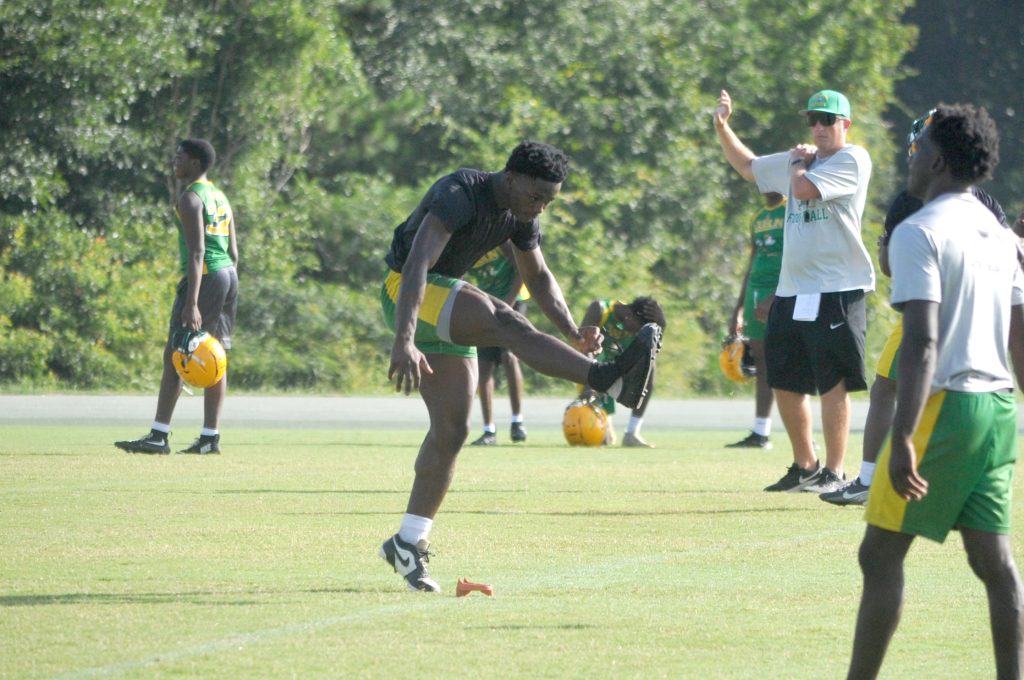
The regular linebacker and tight end will be adding extra-point and field goal duties to his long list of responsibilities this fall. And going by early impressions, coaches seem to think Mitchell will have a shot to be pretty good.
Kicking it old-school…
Though the soccer methodology of kicking is almost universally accepted as superior, it’s also a skill whose many moving parts can make it more technical and difficult to perfect than the alternative.
For those without big-time special teams aspirations, or players like Mitchell whose commitments at many different positions afford little in the way of extra time to practice kicking, the simplicity and repeatability of the straightforward approach (especially if you have plenty of the raw lower body strength that it channels) can offer a lot more bang for the buck.
The specialized shoe isn’t absolutely critical to the discipline, as circular-tipped cleats can still do the job. But for those in this line of kicking, a blunted toe is especially helpful when it comes to, pardon the pun, squaring up the football from a right angle to the line of scrimmage.
“When you kick with a regular cleat like this, you don’t know where the ball’s going,” Mitchell said. “On a kickoff the ball can go out of bounds.”
Square boots were at one point a part of the equipment line of all your major football manufacturers – Riddell, Strider and Spotbilt the brands that were best known for the product.
Unless made as a set, with a standard-pointed cleat to match, the shoes were usually sold on their own to be worn on just the kicking foot, with the other in a player’s usual pair of kicks on the plant side.
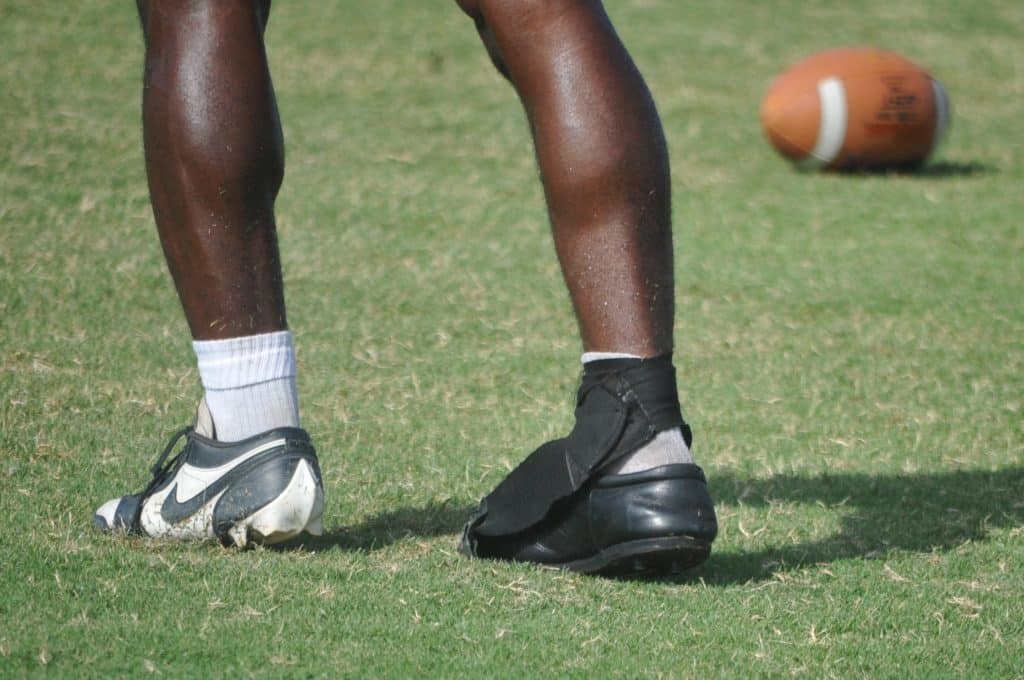
Width and construction of the front wedge varied between different designs, but the leading edge of the sole was typically uniform with the toe cap above.
A departure from that convention, as well as the overwhelmingly old-school look of most models, was the sleek white Nike Boomer, whose nose had a two-tiered pattern with a lower lip extending slightly beyond the perimeter of the more rounded upper lining.
But the vast majority of others you’ll come across, including Dublin’s, are made of the shiny black leather that – save for the spikes – reminds more of a dress shoe than one you’d wear on the gridiron.
This one, which Holmes bought secondhand after taking over as Irish head coach in 2002, looks to be at least 40 years old.
He’s kept the size 11.5 handy on the off chance that it might ever be needed, though for Dublin (which under longtime kicking coach George Hagler, subscribed exclusively to the soccer-style method), straight-on kickers in recent history have been few and far between.
Prior to Mitchell, the last Irish player to use it was Ja’Ques Evans, a member of the 2019 state championship squad with the same profile of a lineman/tight end/linebacker-type, and a surprising amount of power in that simple drive of the leg.
“It makes a big difference for a straight-on kicker,” Holmes said. “If you’ve got a round toe, and you don’t hit it straight down the middle, it’s going to skirt one way or the other.”
Fortunately, the boot did indeed fit when he got it back out of the closet for Mitchell last year, though it had clearly suffered a good bit for age, and needed a trip to the shop of legendary local cobbler Richard Baker for some fixing up in order to make it through last season.
Some more significant deterioration occurred this summer, when the sole came completely undone, necessitating extensive repairs to keep the shoe in working order. That is, unless they were somehow able to get their hands on another one.
A shoe-leather search…
Frank Hobbs, of longtime local retailer Hobbs Sporting Goods, actually recalls locating a square-toed shoe for an area client as recently as five years ago through a supplier out of Waycross whose owner made a point of stocking the vintage item.
“He bought a bunch of them back in the ’80s,” Hobbs said. “Every time we called, he had some, but we would only ask for one or two.”
But these once reliable sources of the product, in the last few years, have also dried up with its discontinuation.
ProKicker.com, a site affiliated with the kicking camps of the late NFL hall-of-famer (and Swainsboro native) Ray Guy, was for years one of the industry’s last remaining manufacturers of the relic.
The company, whose yearly production runs were limited to a small number of shoes per year that usually sold out quickly, ceased making them only a few years ago, when the limited demand for the product – as a company rep Holmes spoke to by phone explained – could no longer justify the cost.
Its current remaining stock, amounting to a closeout rack, includes just a few odd sizes, all for lefties.
After a search of Ebay, Amazon and other used marketplaces yielded the same results, Holmes settled on finding someone who was willing to take on the ambitious project of restoring his existing one, though it turns out shoe repair shops are getting almost just as hard to find as square-toed kicking boots.
The nearest possibility, with Baker now fully retired from the business locally, called for a short ride to Macon, where he’d find a lifesaver in Mallary McClendon, the owner of West End Shop (Macon’s only surviving shoe and leather service provider) on Montpelier Avenue.
Though admitting he’d never worked on this type of football shoe or anything like it, McClendon (who said in a 2020 interview that he takes pride in bringing shoes many would consider a lost cause “back to life”) embraced the opportunity.
“I was like, just bring it, I’m up to the challenge,” he said. “I’m the type of individual that I’ll take on anything. I looked at it as it was essential. They needed it, so I said I’d find a way.”
The shoe was in pretty rough shape when Dublin assistant coach Keaton Wilson first dropped it off and, after explaining the needed repairs, spent an extra couple hours at the shop talking football with McClendon, who so happened to be a member of the Central High School team that won the AAA state championship in 1975.
The job took shape largely “on the fly,” requiring some work and customization well beyond the scope of his average repair. But he did indeed get it looking as good as new.
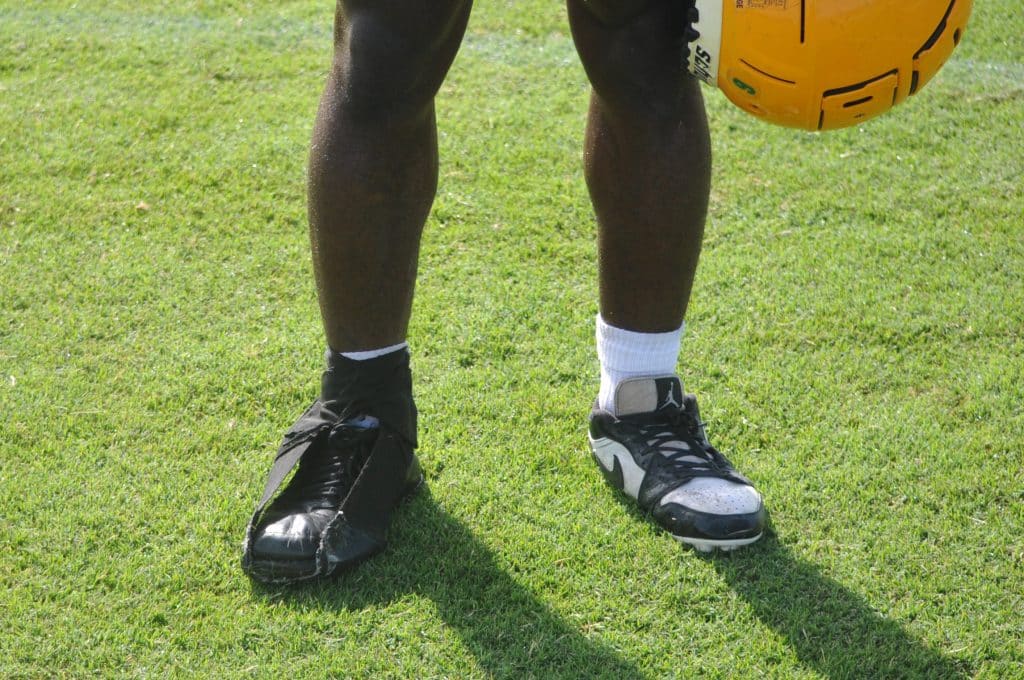
“We took it apart completely, took the sole off and all the inside fillings, and the padding, all of that was replaced,” McClendon said. “Once we were done, we put the sole back on, we stitched it and I put a leather conditioner on the sole because it was cracking, just because it’s so old. It was completely deteriorated. It was where it just needed some nutrients put back in it to make it pliable and bendable.”
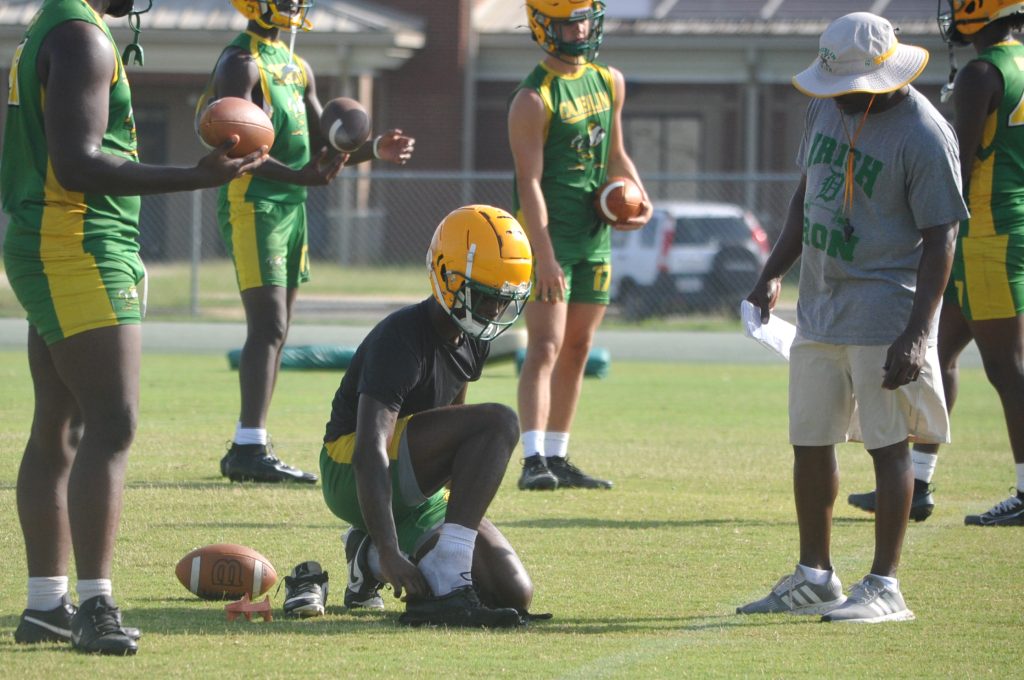
A different Irish staffer, Ryan Green, drove back over this past Wednesday afternoon to pick up the finished product, and had it back home in time for Mitchell to lace up and try out during Thursday’s fourth of five practices in this GHSA acclimation week that Dublin traditionally dedicates to installing special teams.
Besides a few warmup tries, he didn’t get a chance to actually cut one loose over a first hour of work whose focus was mostly onside kicks and extra points.
But the few he was able to blast away at something resembling full power, before putting the regular right cleat back on for the team stretching routine, had an audible thud that signaled a welcome return to normalcy.
“I’m super happy,” Mitchell said. “I was waiting on it.”
Last of a breed…
The straight-on approach to kicking was a way of life in football for much of its early history.
NFL players who were best known for it included Tom Dempsey, who held a longtime league record for longest field goal at 63 yards broken by Matt Prater in 2013, “The Toe” Lou Groza, George Blanda, “Mr. Automatic” Mark Moseley, the only full-time kicker to earn MVP honors, and his former Washington teammate Steve Cox, a punter who ironically made the last successful straight-on field goal in NFL history in 1987.
Hobbs, who played football among other sports at Dublin, recalls an Irish kicker named Chris Howell and a certain other at Dodge County who both excelled at the traditional way during his high school days in the late ’70s and early ’80s, just a bit before the wave of soccer-style kicking from the higher levels would really hit locally.
“When I was playing, most everybody was kicking straight-on,” he said. “We had very few soccer-style kickers.”
Soccer’s proliferation in the U.S. starting about the ’60s led to a paradigm shift pioneered by both its transplants out of Europe, and native-born Americans who began to grow up with exposure to both sports. It brought on the kicking mechanics that are now pervasive at the pro and college levels, in which a player approaches the ball at an angle, and strikes it with the inside corner of the toe.
The style, referred to as “sidewinder” and “sidesaddle,” quickly caught on as it unlocked a greater degree of power and control for kickers, who quickly began to stretch the accepted limits of distance, elevation and accuracy.
There are some pretty sound physics behind why.
Similar to a golf swing, the winding angle of attack and hip rotation creates more footspeed, while the area of impact provides more surface area, and consequently much better odds of hitting the “sweet spot.”
Its introduction to this area is widely credited to the influence of the late Coach Hagler, who mentored Dublin’s kickers for decades and became a sort of guru of the approach, though it’s said that his oldest son Scott actually started out kicking the ball straight before adopting the style that became a family trademark once his father learned its ins and outs later in his high school career.
As the years have gone by, a strong prevailing current of trends in coaching and recruiting toward that new end of the spectrum has largely driven the prototypical technique out of practice, with an overwhelming preference for soccer-style further reinforced by scarcity and cost of the needed equipment to kick straight… which would have also ruled out Mitchell if this boot didn’t turn out to be the right size.
Barring some revival of those old-school special teams tactics and a reboot of the supply lines, it’s likely that most interested parties going forward may have to resort to raiding a museum or conducting an archaeological dig in order to find another one.
“I was thinking, I wonder if we could get him to make three of them?” Holmes said.
But if luck would have it, this repaired shoe will be good enough to get the Irish by for at least this fall, and perhaps a little longer. So for now, they can kick the problem of fulfilling future needs a good ways on down the road.
“Hopefully they’ll win a state championship with that shoe,” McClendon said.
Author

Related Articles
Padded preview: East/West Laurens, Dublin continue season countdown with football jamborees
Another round of padded camps last week put local football teams on the home stretch of their summer preseason prep work, with the first games of the 2026 season now only weeks away.
West Laurens softball’s preseason grind shows why ‘It ain’t easy being a Raider’
The training and team-building activities that make up the Raiders’ annual “Fun Week,” over a few days this time each summer, highlight both the fun and fatiguing sides of team bonding.
Dudley Little League family remembers longtime icon Bobby Locke as ‘life of the party’
The loss of a beloved member of the league’s founding family in April has left many across the town, and its larger baseball and softball community, with heavy hearts as the 2026 season has wound down.