
Laurens County home values up again, but exemption can reduce new taxes
State-mandated reassessments have sent property values on the rise again, but homeowners can find relief with “flating” exemption.
Laurens County property values are on the rise – again – but that does not mean homeowners will see a big bump on the tax bill later this year.
A robust housing market drove up property values for most homeowners, according to recently mailed assessment notices, but the impact on taxes should be minimal. That’s because a relatively new state law limits the taxable increase on homesteaded property values to the annual rate of inflation. So, no matter how much a home’s assessment increases, its taxable value will only increase by about 3 percent.
However, to take advantage of the law’s new floating homestead exemption, homeowners must have filed for the standard homestead exemption tax break.
Property owners have until Aug. 10 to appeal their new assessments, which is also the new deadline for filing for the standard homestead exemption. The homestead deadline is typically April 1, but has been extended so that more homeowners can save.
“I would encourage anybody that owns a home, if they’re not already signed up for the homestead exemption, they need to come up here and get it because that way it protects them, from a taxable value standpoint,” said County Administrator Bryan Rogers.
The floating homestead exemption limits property value increases to the rate of inflation from the previous year, set according to the Consumer Price Index. Last year’s rate, Rogers said, is about 2.8 percent.
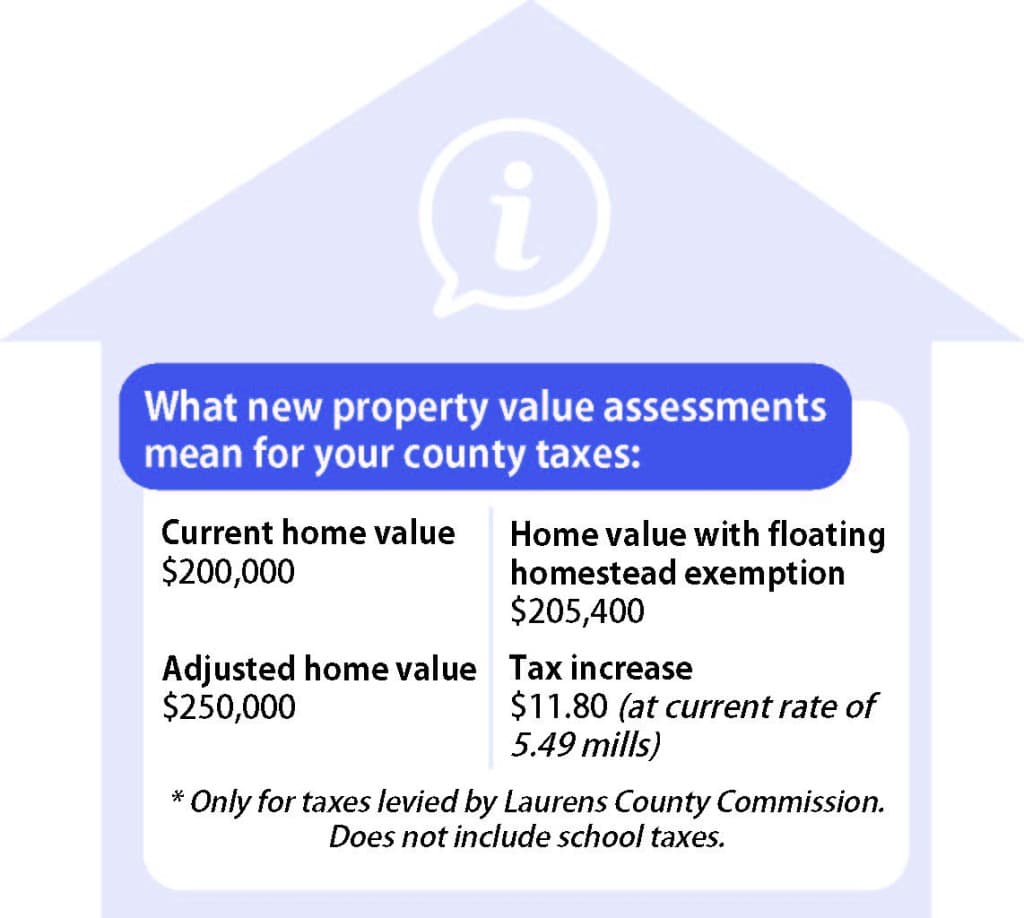
That means a home in an unincorporated area of the county, currently valued at $200,000 but reassessed at $250,000, would only increase in taxable value to about $205,400 with the floating homestead exemption. Taxed at 40 percent and at the county’s current rate of 5.49 mills, the home would incur about $11.80 in new taxes.
However, that is only for the taxes levied by the Laurens County Commission, and does not include those from the county school board. Though the homestead exemptions still apply, school boards levy their own taxes.
Why new property assessments?
Georgia law requires that all properties be assessed at 40 percent of their fair market value. To make sure, the state compares actual market sales to the county’s assessed values of those properties.
That determines what is called the county’s “sales ratio,” and the state Department of Revenue demands that counties keep ratios between 36 and 44 percent.
“They’ll usually pull sales for that year and compare what the homes actually sold for versus what we have been taxing them at,” said Rogers. “That’s how they develop their sales ratio.”
If a ratio is too low, a county can face penalties from the state while also failing to collect property taxes on public utilities at the maximum 40 percent rate.
Laurens County’s sales ratio has been at or below 36 percent for two years, leading to the new assessment notices.
“We’ve been on what I call the state’s ‘naughty list’ for two years,” said Rogers.
“When it gets really out of whack, then you’ve got to do a big revaluation. Instead of doing it every year, where it’s only going where it’s going to keep up with market conditions, all of a sudden people get hit with a 40 percent increase.”
Property owners experienced that firsthand in 2022, when a countywide revaluation sent home values, and subsequently tax bills, surging.
“Everything’s about being equitable,” said Rogers. “If you and I had the same 2,000-square-foot house in the same neighborhood, but you’re paying taxes on your house valued at $10 a square foot more than my house, then something’s wrong. It’s not being fair to you.”
To appeal an assessment…
Residents can appeal their new property values to the county tax assessors office. If unhappy with that result, they can appeal to the county Board of Equalization, a neutral board appointed by the grand jury.
For more information, call (478) 272-6443.
Author

Related Articles
Twiggs County Commissioners approve “slow down” sign on road where a Danville man was killed this summer
The Twiggs County Board of Commissioners approved the installation of a “slow down” sign at the site of a hit-and-run that killed a Danville man back in July.
Laurens County Commission passes tax increase
Officials say tax hike needed to cover inflation, public safety costs.

Smith’s jewelry celebrating 115 years in downtown Dublin
A jewelry store that opened in 1911 will be celebrating its 115th year in downtown Dublin this Thursday.