
The legend of Flintwood: 40 years later, area coaches look back on little-known local sports hoax
From the curious case of Sidd Finch to the NYC Packers, 1985 was a big year for sports media hijinks. Here’s the story of some Middle Georgia coaches who got in on the mischief with a legendary prank of their own.
ROCHELLE – The world of sports has its share of legendary hijinks, like George Plimpton’s invention of flamethrowing Mets pitching prospect Sidd Finch in a Sports Illustrated cover story and a one-time New York City press conference to announce its acquisition and planned relocation of the Green Bay Packers.
There are a number of stories to be told – and hopefully laughs to be shared – about these good-natured pranks that the public, or the press, fell for hook, line and sinker.
Coincidentally, both of the above happened to occur the same year – 1985 – as a much-lesser known sports spoof that originated in Middle Georgia four decades ago this fall.
The story surrounds a group of area high school football coaches who – in the spirit of pranksters that famously filed bogus sports reports from the fictional Plainfield Teachers College in 1941 – pulled one over on the sports department of a Macon newspaper.
At least one of those involved – who we promised to keep nameless – is hesitant to admit his participation, for fear of being perceived as a troublemaker. Several others were plenty outspoken when reached for a few of their recollections, and some more good laughs about a story they re-tell with colleagues on at least an annual basis.
The statute of limitations on practical jokes, we hope, is less than 40 years. But, to rule out any persecution or scorn, they assure us that the following may or may not have actually happened…
If you were to make up a private school, it’d be a good idea to name it something ending in either -wood, -gate or -field (as is true for what seems like a majority of Georgia’s small-town independents) to make it sound as believable as possible.
The late John Milledge head coach Bob Peck, along with several on his staff who now represent branches of a coaching tree reaching across the area and state, imagined an archetypal South Georgia institution when they conceived of the completely imaginary Flintwood Academy somewhere in the midst of the Trojans’ 6-0 run to open the ’85 season.
The school, based in Wilcox County, attributed the first half of its name to the nearby Flint River, and carried a combination of red and yellow as its colors.
“I think the joke was they were like maroon and gold plaid,” said Coach Peck’s son Tyler, who was only two years old at the time of Flintwood’s creation.
Its mascot, the Spartans, was merely the best-sounding of suggestions also including Lions, Tigers and Bears that were tossed around the room one day as the group killed time around the office.
“We just love cutting up with each other as coaches like to do,” said former JMA assistant Tommy Cain, who’s now coaching in semi-retirement at Brentwood. “It was us four coaches sitting around the office.”

This collection of tricksters, Peck in particular, was especially notorious for the running antics that were quite common within the “fraternity” of area high school coaches at the time.
“They were always messing with each other, and they’d mess with the media, too,” said midstate journalism legend Ed Grisamore, a longtime Macon Telegraph staffer who now writes for the Macon Melody, a sister publication to The Courier Herald.
To fully understand their game of pretend, though, you have to go back in time to what most media types would look back on as a golden age in the industry, predating social media, scoreboard apps or even the Friday-night football highlight shows that are now among the many ways fans can follow the local high school action.
In that era, unless you attended games or listened on the radio, the only way to find out what happened was to pick up the next morning’s newspaper to read about them.
At the time, Middle Georgia’s largest daily newspaper was the Telegraph. And it, like The Courier Herald and other community print outlets on a smaller scale, made a practice of gathering as much on area games as it could before evening deadlines to print as box scores and blurbs in the next edition.
But as was the case for most events not being covered by a dedicated reporter, the responsibility fell to coaches or other close followers of schools to call their game results into newsrooms where an army of folks would be working the phones and jotting down scores and short recaps all evening.
These JMA coaches faithfully made sure that the details on scores and scorers from their weekly games were submitted each Friday night.
So they found it a bit bemusing when, over a few seasons leading up to 1985, those scores and results, upon a glance at the Saturday sports pages, were usually nowhere to be found.
“We had tried for what had seemed like forever in the previous years to call our scores in religiously after the game, win or lose,” said the active area coach who requested to remain anonymous. “You’d have your stats, give them to them, and you’d get a little recap in there. But it never seemed like our stuff made it in there.”
“We’d call our game in and get up Saturday morning and look in the paper, and no John Milledge,” Cain said.
At some point during that ’85 season, Coach Peck and those assistants – sensing some type of snub – cooked up a mischievous idea to poke a little fun in the other direction.
And the mythical Flintwood Academy was born.
“I don’t know whether it was during film session or what, but one of the four people in the room said I bet we could make up a school, and we could get more coverage than we received as a legitimate school,” the nameless coach said. “So we tried it one Friday night. This was also before Caller ID and all that stuff, so most folks weren’t expecting somebody to play a practical joke on them. But as I’ve learned, we weren’t the only ones that have done that through the years.”
Grisamore, at the time, had recently stepped down from an editor position – in which he at first presided over the paper’s prep sports coverage, and later the full sports department – in order to rejoin the paper’s rank-and-file of reporters and get back to his first love of writing.
While he doesn’t recall this specific instance of misinformation coming to his attention, it was one of many efforts over the years by clever callers to sneak something by them during what was always a weeknight frenzy.
“That was that generation’s version of fake news,” he said.
And covering at least 80 different high schools from 26 or more Middle Georgia counties, with results of games coming in just about all at once over a couple hours on Friday nights, made for a mad dash getting the sports section to print.
“People are always trying to mess with you,” Grisamore said. “It was very easy in the heat of battle for some things to kind of slip through.”
If you’re going to pull a prank, you might as well put some work into it.
And this self-appointed committee went well out of its way to dream up a proper storyworld, and characters, to make this private school of make-believe seem legitimate.
Flintwood played in a league made up mostly of recently defunct Georgia private schools (like Gordon Ivey, One Way Christian, Beechwood, Pathway Christian and Ravenwood, its inaugural opponent) with a roster of players sharing the names of various people in their rolodex.
Somehow, they managed to pass off the scores and results from a previously unheard-of program as real upon calling in, separately, to submit the parody results along with their usual game report.
“Sure enough, after we did it the first time, we got up the next morning, there it is,” Cain said. “Flintwood, and no John Milledge. That’s how it all got started.”
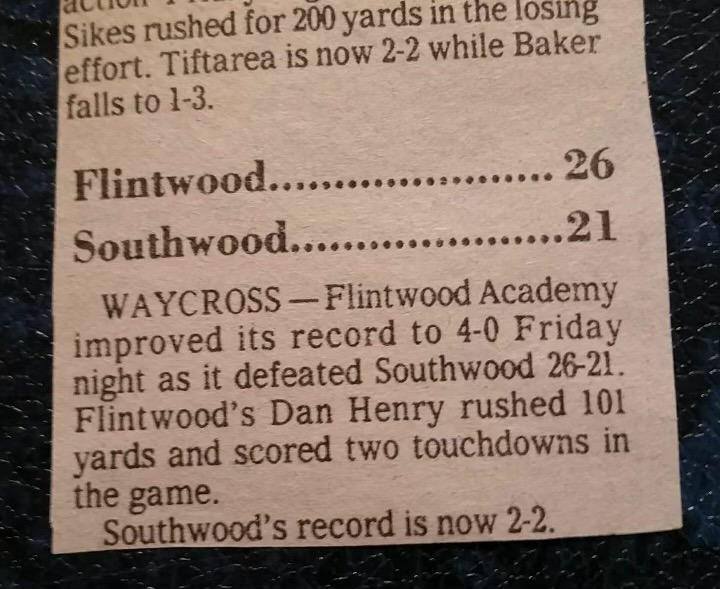
Their game continued the rest of the football season, and after a few weeks, began to take on a life of its own as a couple of the fictitious athletes quickly became Spartan legends.
Ricky Burgess, who in real life was an Albany-based sporting goods sales rep, and running back Dan Henry, whose name was shared with a well-known GISA football historian out of Sandersville, got some of the most weekly ink.
“Henry was an All-American high schooler,” Cain said. “Nobody could stop him.”
Plenty of others would moonlight in the box scores, often names that would be recognizable only to certain others in their circles who they knew would be perusing the sports pages.
“I don’t remember a lot of the other names, but I thought that was pretty creative from the coaches just using different guys that most of the coaches around Middle Georgia knew,” said Edwin Cook, who became a faithful Flintwood fan after playing under Peck at John Hancock Academy.
Most of these knew to keep an eye out for something new and surprising that would be hidden between the lines of each week’s box score.
“A lot of the coaches back then knew it, but they were not in on it,” Cain said. “They looked forward to looking for it, too. It just grew and grew and grew. It was just fun. I hope we didn’t get anybody in trouble.”
The scheme turned out to work so well, they carried it over into basketball season, in which the paper’s game capsule format – listing out each of a team’s scorers next to their point totals – presented some new creative opportunities.
While Flintwood’s core of players remained the familiar football names, the opponents’ came from a number of places. Eventually, coaches from other schools in the association would begin making cameo appearances in the write-ups.
“They would look ahead and see who was playing who so they could pick a team that wasn’t on the schedule,” Tyler Peck said. “That would be who Flintwood was playing, and I know that they would use like other coaches’ names as the players. Coaches in the league would go buy the paper and see if their name was used.”
The Spartans’ girls basketball roster, in another wrinkle, was made up of re-spelled names of professional wrestlers, their leading scorer Bobbie Slaughter taking after the well-known “Sgt. Slaughter.”
They’d go even further, when reporting certain games, to have the listing of top scorers spell out a cryptic or humorous message that only those skimming over the lines of copy would be able to pick out.
“The football, it was mainly just the stats and all, but they got even more creative during basketball season, and they would get a story that was actually a headline story in the Macon Telegraph, then they would use that in the box score of the basketball games, and they would kind of repeat the story that was in the headlines,” Cook said.
The stunt lasted through about Christmastime, but would ultimately run its course as the ruse became more and more challenging to keep going.
Soon enough, they were bound to overlook an issue of script continuity that would tip their hand, and that’s what happened with a late-December report from Flintwood’s holiday hoops tournament that incidentally included a team they didn’t realize was playing in a different event on the same night.
The duplicate score likely alerted the Telegraph to the scam, although recollections differ about whether a member of the group was ever directly informed they’d been found out, or that they only feared as much, and decided to stop on their own.
“Somebody’s game got rescheduled and they didn’t know, and apparently they used a team that had already played or something. They said, ‘We’ve already got a score for them,'” Tyler Peck said. “They realized what happened, and they basically said, ‘Don’t call in a Flintwood score again.'”
Though that was the end of its run in the papers, the school’s folklore has lived on for 40 more years as an inside joke among members of that JMA staff, as well as their colleagues and assistants who continue to re-tell the tale.
“It definitely became a legendary story amongst GISA coaches,” Cook said.
In fact, you’ll probably hear more about it from people who were never directly involved, but keep the tradition alive by, every few years, writing out social media posts in the form of those old game dispatches.
And it would so happen that Flintwood’s football squad hasn’t lost a game since that 1985 season.
“It’s cool that after 40 years, people are still talking about it,” Tyler Peck said.
They also went so far as to print up some pieces of Flintwood Spartans memorabilia that have circulated amongst the large community of folks who can now say “IYKYK.”
“Some of the folks that I see on that chain of text messages, they weren’t even coaching when it came up, and they were buying T-shirts and stuff, so it’s kind of become cult fiction,” the unnamed coach said.
To what extent did the Telegraph actually catch onto the hoax?
It’s unclear, given that most of its sports staff has long since moved onto other things. And the coaches, for their part, never got around to letting anyone on the paper’s end in on the joke.
“I’m sure they had to catch wind of it at some point,” Cook said.
There’s a good chance, Grisamore confirms, that the spurious information would have been a simple oversight for one of the part-timers, mostly local high-schoolers, they had on hand to take down the reports.
In fairness, it was also much more difficult in 1985 to verify many facts that are now a Google search away from being confirmed, or debunked. And even to this day, it would also probably surprise you how many tiny private schools exist in certain places that you’ve never heard of until a local sports team happens to schedule them.
For even the most experienced and scrupulous editor, on that short timetable, it was quite easy to get duped.
“You have a window of time where everything’s just kind of flying around, it’s like being in battle,” Grisamore said. “The phone’s ringing constantly, and you’re handling a lot of stuff in an hour and a half to two-hour time period. It’s just the bullets are flying on deadline. I can remember sending stuff down last minute and barely reading it at all. You just have to kind of trust that whoever typed this up got it right, and they didn’t always do that.”
Each of the coaches who were involved have long since moved on from that younger, rebellious side that, now, probably seems a good bit out of character, especially for those who have gone on to become respected head coaches and administrators that aren’t at all known for stirring the pot.
“I don’t know that I would say I’m proud of it,” the anonymous coach said. “But it was fun.”
The adventure, reminding a lot of those youthful, carefree days in coaching, is one they mostly relive on the rare opportunities that come along to catch up and share a few good laughs over what, if it were more widely publicized, might rival many of history’s great sports capers.
“Every now and then, somebody’ll post on Saturday mornings as kind of a coaches thing we’ve got going on,” Cain said. “Flintwood defeated so and so. We make up stats and everything, and everybody just loves it. Flintwood still lives today… in infamy.”
Author

Related Articles
FOOTBALL OUTLOOK: Region leaders, playoff hopefuls face key tests in week 10
This is the point in the season, only days from Halloween, that top teams have the most to fear, with the risk of spooks, scares and upsets rising higher and higher each Friday as playoff time gets closer.
MIDSTATE FOOTBALL ROUNDUP: Bleckley wins quality QB duel at Dodge; Brentwood survives barnburner at Briarwood
The Royals and Eagles prevailed in two close grudge matches, the Bulldogs and Vikings handled some key region business and more highlights of the Heart of Georgia’s week 9 high school football results.

PLAYOFF NOTEBOOK: East Laurens softball eliminated by Berrien, West Laurens volleyball falls at NW Whitfield
Postseason road trips ended with elimination for two local teams in the past week as the Falcon softball team went south to Nashville Monday and the Raider volleyball squad north to Tunnel Hill last Friday.