
City school officials say most systems opting out
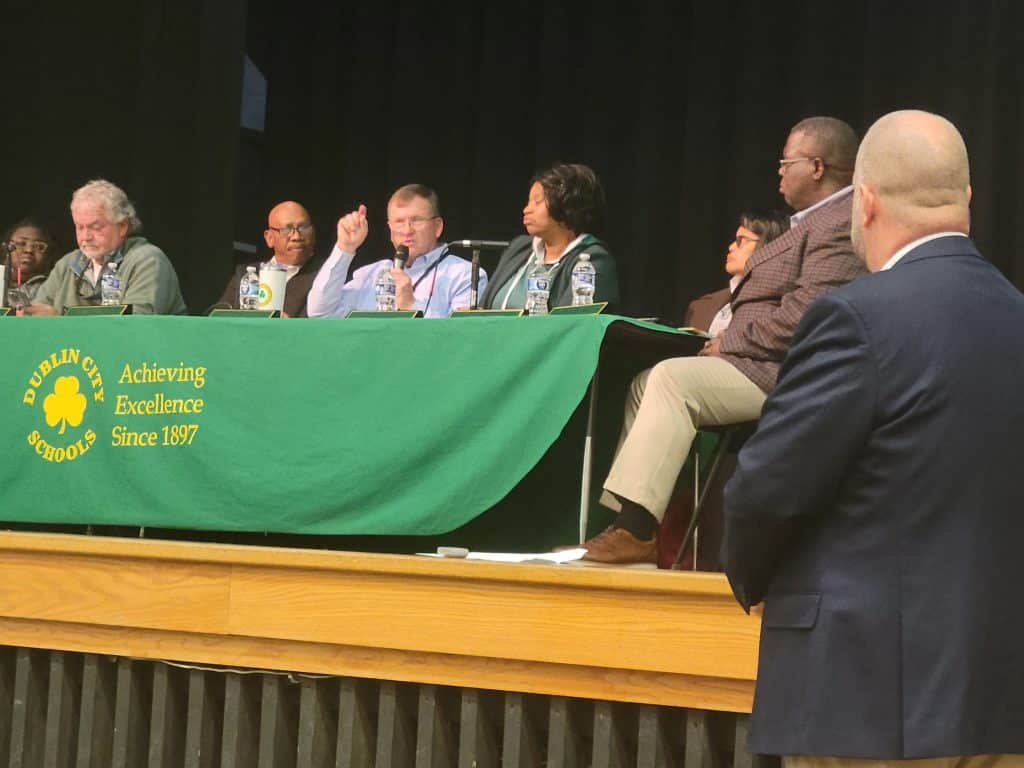
More Georgia school systems are opting out of House Bill 581 than staying in, Dublin City Schools board members and officials pointed out during the second of three public hearings on the issue last Tuesday.

More Georgia school systems are opting out of House Bill 581 than staying in, Dublin City Schools board members and officials pointed out during the second of three public hearings on the issue last Tuesday.
The tax relief bill became law after it was passed by voters last November to eliminate stress on homeowners concerned about rising property values and property taxes. Since the Dublin board held its first public hearing earlier this month, 85 percent of Georgia’s school districts have indicated that they plan to opt out, said Dublin City Schools Finance Director Chad McDaniel.
McDaniel showed the board a map that highlighted the number of schools opting out in green, which took up majority of Georgia.
“Anytime you see nearly 85 percent of the school districts opting out, it should give you pause,” said school board vice chairwoman Regina McRae. “We made a decision based on our own local community. My interpretation is that what they are presenting is problematic.
“There’s not enough answers to questions that have been asked, and you’ve got majority of the school systems saying this is not a good fit right now. This is something that is widespread in the state of Georgia.”
According to McDaniel, only seven school districts, one being Laurens County, have opted to stay in.
“There has been a lot of correspondence that we have received about city municipalities who are looking at the process of opting out because of the lack of clarity and exactly how this bill is going to impact their tax digest,” McDaniel said. “Ultimately for a school district, this comes down to state control versus local control. This bill would give the state the authority to set that cap rate, whereas right now our school board has the authority to set the millage rate and have it impact the tax digest as the tax digest comes. That gives our local school board the control to manipulate and set the millage rate. (Staying in HB 581) would give the state more control over our tax digest. That is ultimately a concern for our school board.”
Board member John Bell believes people did not know what they were voting for when it came to HB 581.
“We have until March 1 to have all of these hearings, and then whatever you did this year it is done,” Bell said. “It’s permanent. You can’t change after this. That is wrong.”
McDaniel said the process of opting out could not begin until after Jan. 1, 2025. If the process is not completed, and filed with the Secretary of State by March 1, that particular governmental agency is bound to House Bill 581.
“You would never had an option to get out of it again,” McDaniel said.
Because the new law is considered a local exemption, McDaniel said, it would impact their state dollars.
“The value in our tax digest that this could bring would be factored into our state funds and what our local far share ends up being, but ultimately it would reduce how much we could receive in taxes,” he said. “Essentially, it’s going to change our multiple tax revenue and impact increasing our state revenues as a school district.”
McDaniel showed a slide that showed that the local property tax makes up 32 percent of the school system’s budget and the state QBE funding makes up 42 percent of the overall budget.
“The concern is that our two biggest categories would be negatively impacted by House Bill 581,” McDaniel said. “This would lower property tax and lower state funding, thus impacting the school system negatively in that regard.”
McDaniel and Dublin Superintendent Fred Williams received permission from the board to look into a senior homestead exemption.
“Our board is looking at creating an exemption for our seniors who are 62 and up, 65 and up, and 70 and up,” McDaniel said. “We’re looking at those three brackets and putting into place a lower exemption for our seniors. Currently in our community, we have a homestead exemption for 62 and 65 but the income requirements are pretty low for what’s allowed with that particular exemption. We’re investigating looking at that homestead exemption and raising the income requirement so that more seniors could qualify for that exemption.”
McDaniel said HB 581 is a floating homestead exemption that would create a cap for property value increase in a given year. As of the meeting on Tuesday, the state had not said what metric would be used. For the example during his presentation, McDaniels used the inflation rate. He said if the inflation rate was 4 percent, and a home’s value went from $100,000 to $120,000, that would cap the value that a person’s home could increase at 4 percent.

“Even though your home may be worth $120,000 based on your tax re-evaluation by the tax assessor’s office, it would be capped at $104,000 based on this floating homestead exemption,” McDaniel said.
Local governments and school boards only have one chance to opt out of House Bill 581. If they do not opt out, they would lose local control of a big part of their funding.
The law does allow municipalities and counties to ask for and put into play a one penny additional “FLOST,” or floating local option sales tax, McDaniel said.
“That would help cover any tax digest losses they may have,” he said. “This is not something that the bill authorizes for the school districts.”
Board member James Lanier stated that if the Legislature had left the one cent option in for the school boards, there would be no reason for any school system to opt out.
“It would have eliminated a lot of the problems that we have and it would eliminate the millage rate problem that we have,” Lanier said. “It would allow the school systems to reduce the millage rate considerably if it was funded by a sales tax.”
Bell agreed.
“If we would have the right for the citizens to vote for that one percent sales tax for schools, it would save a whole bunch on the millage rate,” he said. “I know what I would go for. I wouldn’t opt out. … If we didn’t opt out, five, six to seven years from now, I would imagine the millage rate would have to have been raised if we didn’t opt out.”
McDaniel said the impact from HB 581 will be seen five to 10 years from now.
“Knowing that you can never opt out is the part of the concern about this particular bill and the way it is structured,” he said.
Just because the city school board is opting out, that will not have an impact on the abililty of the Dublin City Council and the Laurens County Commission to put the one penny FLOST in place, McDaniel said.
During the public participation part of the hearing, neither of the two members in the community who attended the meeting signed up to speak, bringing a close to the hearing and meeting.
The last of the three public hearings required to opt out will be held at noon on Friday, Feb. 7, also in the Dublin High School auditorium.
Author

Related Articles
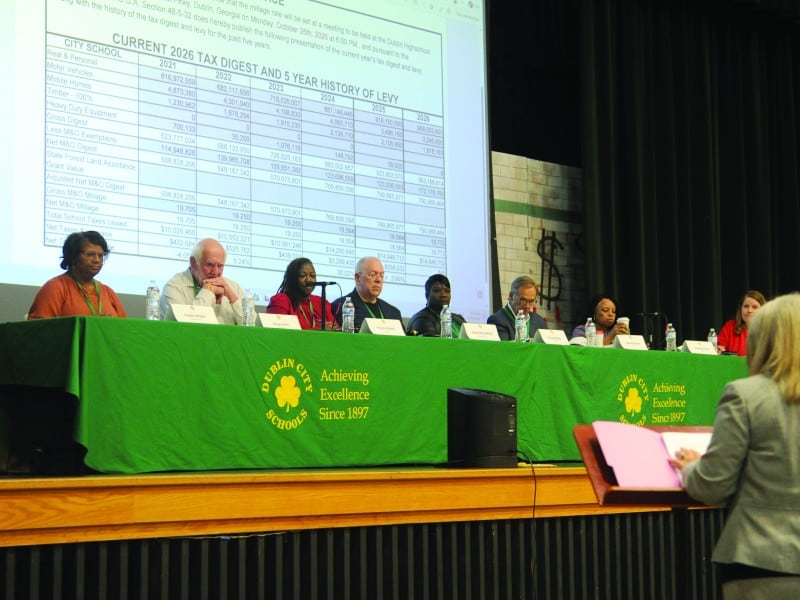
Dublin school board OKs tax increase
Board says tax hike is “revenue-neutral” and will offset revenue lost to new senior citizen exemption.

Multiple Treutlen governing bodies propose adjustments to millage rates
Multiple governing bodies in Treutlen County have announced plans to adjust their individual millage rates following reassessments of property values in the area.

Pilot Club Christmas ornament stirs memories of old Claxton Hospital
“We’ve already sold at least 300, and we got them in (last) Wednesday,” Pilot Club member Sherry Mangum said Monday. “It’s been a great response.”