
Dublin would be first school board in a decade suspended by governor
Local board members face removal from office after hearing before state Board of Education.
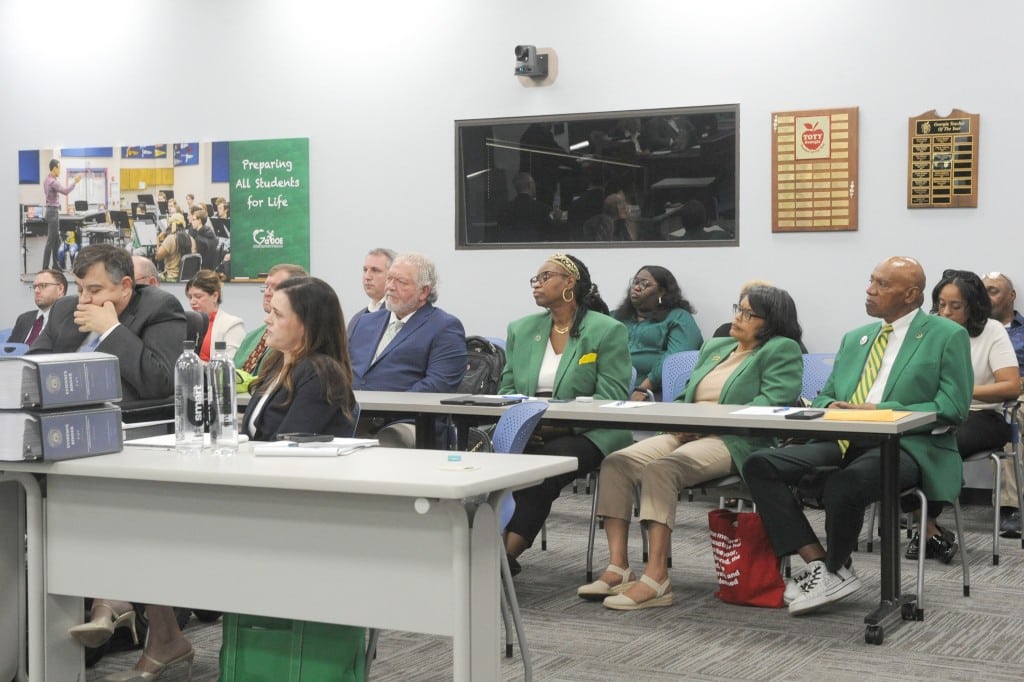
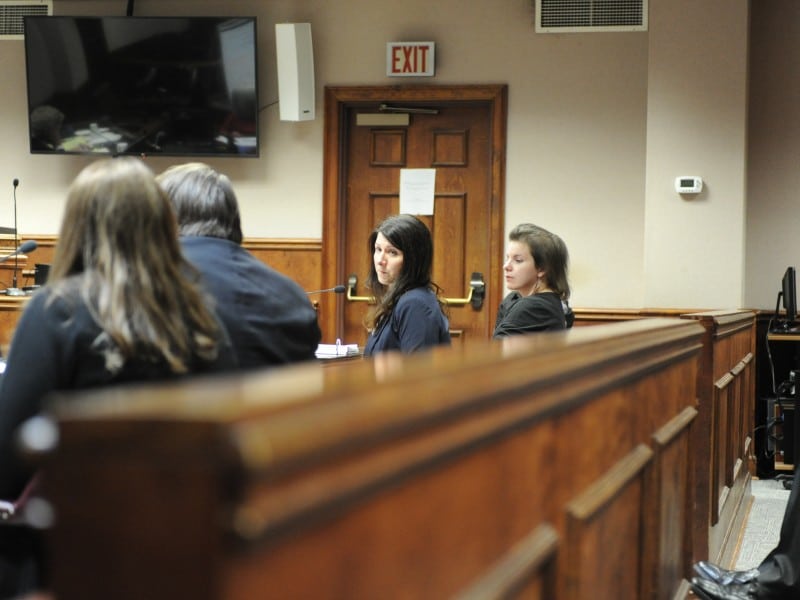
Dublin school board attorney Mitch Warnock and members of the Dublin City Board of Education listen to testimony Wednesday during the board’s suspension hearing at the Department of Education in Atlanta/RODNEY MANLEY
ATLANTA – The last local school board suspended by Georgia’s governor was faulted for micromanaging its district. Dublin City, which could be the next, is accused of being asleep at the wheel.
The fate of the Dublin board’s members now lies with Gov. Brian Kemp after an almost 11-hour marathon hearing concluded Wednesday night with the state Board of Education voting 10-0 to recommend their suspension.
The hearing was required by law after Dublin City’s accrediting agency, Cognia, downgraded the district’s rating earlier this year to the lowest level before revocation. Accreditation might have led to the hearing, but state lawyers said the ongoing financial crisis that threw the system into survival mode, along with the Dublin board’s historically poor history of managing its money, is proof its members should be removed.
“How in the world can you trust this board?” asked David Younker, lawyer for the Department of Education.
Wednesday’s hearing happened a year after it was revealed the school system mishandled teacher and staff portions of insurance payments and failed to make payments to the state benefit plan. Board members testified they were blindsided last August when learning they owed more than $6 million in overdue payments to the State Health Benefit Plan.
They blamed former finance director Chad McDaniel, along with his predecessor, Christi Thublin, and former superintendent Fred Williams, alleging that McDaniel misled board members into believing the district’s finances were sound. They also accused him of using the $6 million that should have been paid for state health benefits to cover up the money troubles.
“Finance director Chad McDaniel deceived, misled, lied to and betrayed the Dublin City Board of Education,” said school board attorney Brian Smith. “For years he willingly and knowingly hid the true state of the district’s finances.”
McDaniel took the stand, but provided no answers. With state and federal criminal investigations into the finances still ongoing, he repeatedly invoked his Fifth Amendment rights, refusing to respond to a series of Smith’s questions that included whether he ever provided false financial information and if he had been trained by Thublin to do so.
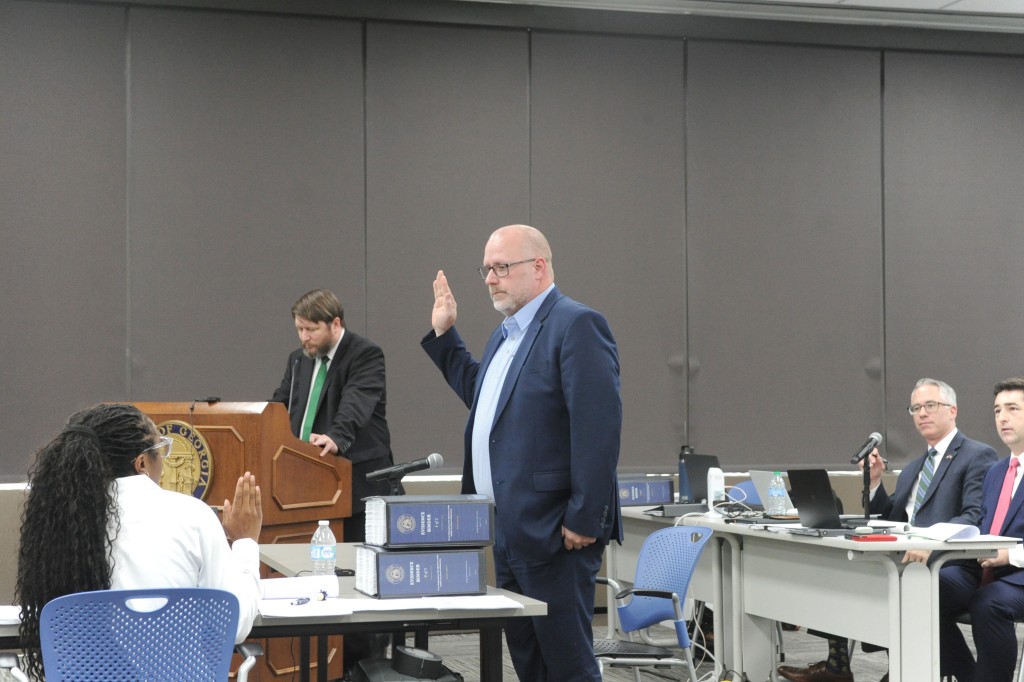
Former Dublin City Schools finance director is sworn in before testifying. McDaniel answered no questions about finances, invoking his right to do so under the Fifth Amendment. On the table before him are two 3,800-page binders of financial records submitted
by the state as evidence/RODNEY MANLEY
“Fraud has been committed against the taxpayers and the Dublin City Board of Education,” Smith said in his closing argument. “You can infer Chad McDaniel is pleading the Fifth because he’s got something to hide.”
Records show the district also delayed payments to the State Health Benefit Plan for months in 2023, when Thublin was still over finances.
Younker, however, laid the blame at local board members’ feet, noting the board had operated in a deficit for two decades before an influx of more than $19 million in COVID relief funds allowed it to balance the books, briefly, from 2021 to 2023.
“In a district serving 2,300 students, they burned through $20 million and they were still $13 million short in 2026,” he said.
Even in the few years it appeared to be out of the deficit, the school district continued its pattern of deficit spending – or paying out more money than it took in.
Younker introduced numerous documents as evidence, including 3,800-page binders provided to each state board member and a lengthy slideshow presented during closing statements. One slide was a Department of Community Health email, which read, “It is considered fraud to not remit money withheld from employees’ paychecks and Dublin is in non-compliance…”
The evidence also included monthly financial reports from fiscal year 2025 that showed the district in a deficit for the entire year, some months showing as much as $7 million in the red, that were signed by all the board members.
“They signed the reports,” Younker said of the board. “They signed all the plans.”
‘Drinking their Kool-aid’
Dublin board chairwoman Amanda Smith and others testified that whenever board members questioned the negative numbers, they were always provided some explanation. She described board members as “furious” at a called board meeting last August they first learned of the more than $6 million owed to the state health plan.
“Chad told us, ‘I was told not to tell by the previous director.’ I said to him, ‘This is going to be the nail in our coffin,'” said Smith. “You’re fighting for a system that everyone else is fighting and, for the lack of a better word, drinking their Kool-aid.”
That mismanagement forced to board to a number of hard decisions last fall that included midyear terminations of about 50 employees.
“We had to do what we had to do to keep these doors open,” said Chairwoman Smith. “It’s heartbreaking. You recruit people to your district because you love schools, and then you’re looking at some of your best friends and saying, ‘I’m sorry. There’s nothing I can do.’ It was heartbreaking for all of us.”
Amy Rowell, director of the Georgia Department of Education’s finance review and grants accounting division, testified the school board was aware months earlier that the district was in a significant deficit. She said the board had filed a deficit reduction plan in January 2025 after unaudited information alerted state officials to the shortfall.
At the time, the board had not finalized an audit since 2022. It is still waiting on 2024’s and 2025’s.
Rowell was one of three state Department of Education employees assigned to provide assistance in straightening out Dublin City’s books. She described the financial struggles as a “systemic problem,” noting the district has been in a deficit almost every year since 2009.
“There’s not another district that has had the level of financial difficulty for this long,” she said.
Board members could petition for reinstatement
While highlighting the long-running fiscal issues, the state also sought to portray the existing board as unfit to lead, pointing to several recent split votes, along its 4-3 racial makeup, as its four white members forcing their will on the rest of the board.
Six of the Dublin board’s seven members testified. Only John Bell, the longest serving member with 26 years on the board, did not.
Its three black members – Peggy Johnson, Kenny Walters and JoAnna Glover – all said that despite recent disagreements, the board can work together to turn the system around and keep its accreditation.
Board members also testified the schools were making progress toward meeting Cognia’s accreditation findings and had passed a balanced budget.
However, both Jeff Davis and Peggy Johnson said under cross-examination that they stood by statements both made during earlier board meetings, when they suggested that perhaps the local board should be suspended.
“If y’all think getting rid of me will help the kids, then get rid of us,” said Davis said, who only took office this past January after unseating incumbent Regina McRae.
Dublin’s would be first school board to be suspended by the governor for low accreditation ratings since Dooly County in 2016.
The state Board of Education has up to 15 days to notify the Dublin board and the governor’s office of its recommendation. The law allows Kemp to suspend the board members, with pay, and replace them with appointed members.
If suspended, Dublin’s board members can petition the governor individually for reinstatement, which would be decided at another hearing. Any board member who does not petition would be permanently removed.
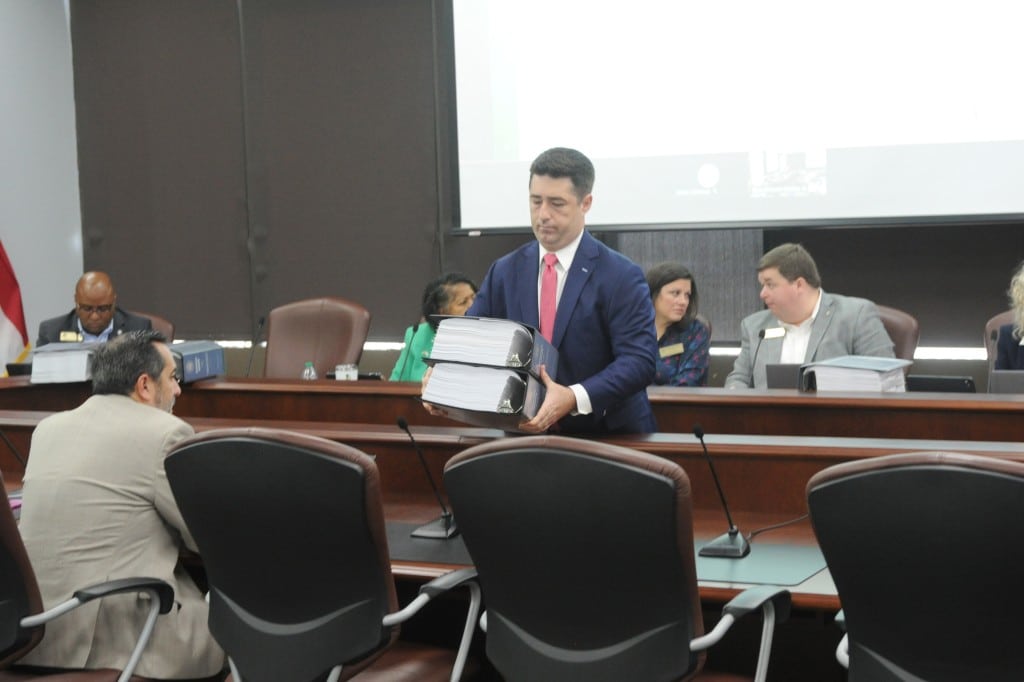
David Younker, an attorney for the Georgia Department of Education, distributes 3,800-page binders of Dublin school financial documents to members of the state school board/RODNEY MANLEY
Author

Related Articles
Twiggs County animal control proposed for 2027 ballot, other updates from last week’s county commission meeting
Twiggs County commissioners discussed the possibility of putting animal control on the 2027 ballot at last week’s meeting.

East Laurens Band of Gold playing the hits of the Jackson 5
The East Laurens Band of Gold will be jamming to the Jackson 5 this football season.
Judge rules in favor of fired Dublin teachers
A Dublin Superior Court Judge has ruled in favor of two former Dublin City school system employees who say they were wrongfully terminated by the embattled district.