
Dublin school board cites progress ahead of suspension hearing
District says it has addressed review findings that jeopardized its accreditation.
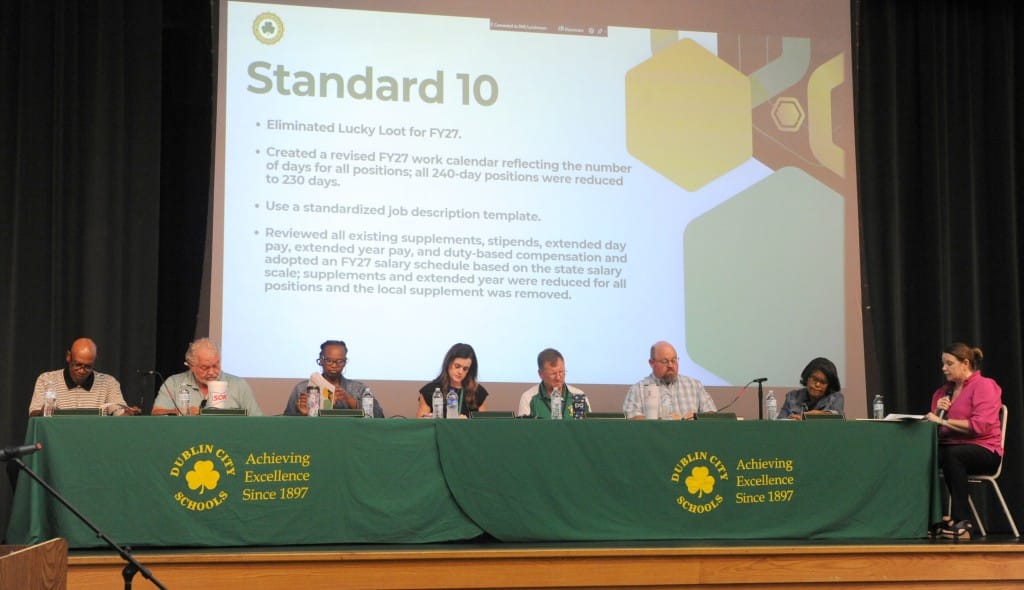
Interim Superintendent Marcee Pool (right) gives the Dublin school board an update on the district’s progress in addressing problems from a recent accreditation review. The school board faced a suspension hearing Wednesday in Atlanta because the district’s accreditation was downgraded to the lowest status before revocation/RODNEY MANLEY
The Dublin City Board of Education made no mention Monday night of its pending suspension hearing, but did continue to make its case with updates on progress toward keeping district accreditation.
The board faces a hearing Wednesday in Atlanta before the state Board of Education, which will recommend to the governor whether local board members should be suspended. The formal hearing is required by law after Cognia, the district’s accreditation agency, downgraded Dublin City to “accredited with conditions” – the agency’s lowest status and a required step toward dropping accreditation altogether.
Interim Superintendent Marcee Pool outlined at Monday’s workshop some of the steps the district has taken in response to Cognia’s findings, including tighter financial controls and reporting, improved personnel recordkeeping and across-the-board reductions in salary supplements and additional-day pay.
Other measures have included the hiring of a new chief financial officer, a purchase order review process and monthly reconciliation of credit card activity. Also, all positions now must be approved by the school board.
“These are things we are already starting to do,” Pool told the board.
She also addressed past transparency issues. All meeting notices are now posted on the district’s website on the Friday before each Monday meeting, and the agendas are being sent to The Courier Herald on Thursdays to meet the newspaper’s weekend deadline.
“Our meetings are on Facebook live, and usually our newspaper is here,” Pool said.
Accreditation review finds more than just money problems
Wednesday’s hearing before the state school board was triggered by a Cognia review conducted in February, with the school district mired in a financial crisis.
Parents, teachers, even board members and high-ranking staff told Cognia interviewers they were left in the dark as the district burned through $4 million in federal COVID funds to cover payroll and other bills from 2021 to 2025. During that time, the school system employed more than twice as many staff members whose salaries did not qualify for state funding as its peer systems, instead relying on local tax dollars and federal funds to pay for the positions, according to a report on the review team’s findings.
Staffing decisions “lacked sufficient transparency,” the report said, with pay levels and positions often decided at the top with no input.
The review also revealed “recurring patterns” across multiple areas that appeared to fall short of legal and regulatory requirements. Those problem areas included the conduct and documentation of meetings, financial decision-making processes and personnel management practices.
The report documented eight meetings – in addition to six budget and tax increase hearings – that were held last year which the school board failed to post notice of on its website. Reviewers also cited “recurring deficiencies” in recording and publishing minutes from board meetings.
The review found almost no internal controls related to employee compensation. It also found the system spent more on salaries than comparable systems and provided disproportionately high coaching and extended-day supplements. According to the report, Dublin City Schools paid more than three times what similar school systems paid for extended day supplements and more than double what peer school systems paid for extended year supplements.
A subsequent examination by the state Department of Audits and Accounts revealed a widespread lack of financial controls, patterns of overspending, over-hiring and lax bookkeeping and even personal usage of district credit card. Also, for at least eight months the district withheld insurance and benefit premiums from employees’ paychecks, but never paid that money to the state until it got caught.
The district’s finance director, Chad McDaniel, resigned last August, shortly after state officials disclosed the money owed for unpaid health plan contributions. Superintendent Fred Williams then stepped down in September to take an early retirement.
New budget reduces spending
The district could point to its leaner budget for fiscal year 2027 as evidence of its financial progress.
The board on Monday approved a $41.1 million budget, which marks a significant cut from the $47.5 million spending plan the board approved last year. The new plan calls for the fiscal year to end with a general fund balance of $821,314, but the district will still carry over more than $5.5 million owed for past-due payments to the State Health Benefit Plan.
The school district has struggled financially for years, but its most recent cashflow problems were not revealed until last August when state officials determined the district owed more than $6 million in overdue payments to the State Health Benefit Plan.
The budget calls for the system to continue its monthly payments of almost $300,000 to the state.
Last fall, the state projected that the school district would finish FY26 with a $13.4 million deficit.
State School Superintendent Richard Woods later said that the widespread issues with budgeting and spending controls that officials uncovered had put the district on a “path to insolvency.”
The district struggled to survive the past school year, cutting more than 50 teaching and other staff positions, but still had to rely on advances of its monthly allotments of state funding to meet payroll and other expenses during the school year.
In addition to its money and accreditation troubles, the school district faces more challenges on several other fronts – such as pending lawsuits from fired teachers and an ongoing criminal investigation by the Georgia Bureau of Investigation.
Author

Related Articles
Dublin board suspension hearing: Live updates
The Dublin City Board of Education blamed its financial crisis on “multimillion dollar fraud” by its former finance directors, a school attorney argued Wednesday at the board’s state suspension hearing.
Montgomery Residents Speak Out on Data Center Issue
Three Montgomery County residents spoke to the Board of Commissioners on the issue of a potential data center during the board’s August 6 work session, each tackling a different aspect of the issue.
Middle Georgia Prep official discusses taxes and new school – Will it affect yours?
People have been asking if their taxes were going to rise after Middle Georgia Preparatory Academy was approved. Leaders answered that question.