
Up the creek: Dudley looking for solution to wastewater issues
City’s treatment pond maxed out, making it susceptible to spillovers into Turkey Creek.
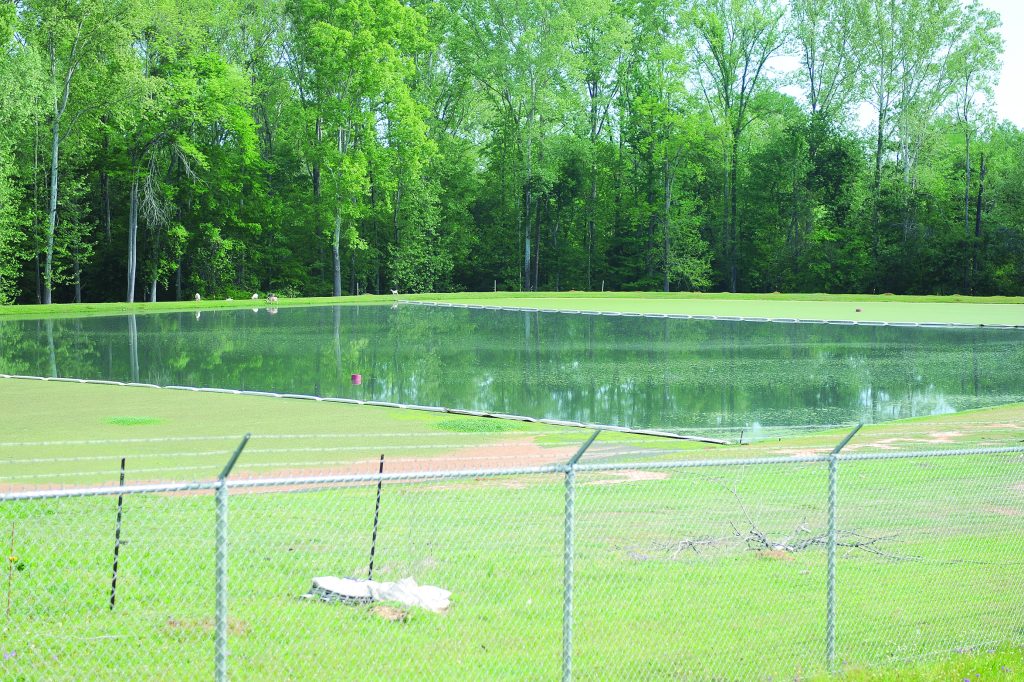
The city of Dudley has outgrown its wastewater treatment pond and is exploring options through the Universtiy of Georgia Archway Partnership/RODNEY MANLEY
Two years ago, Jesse Everett and his brother, Jimmy, parked at a nearby bridge and slogged down Turkey Creek to where the city of Dudley’s wastewater pond feeds into the stream.
Everett had long suspected that following heavy rains, untreated runoff had been spilling over the pond’s bank and into the creek. After noticing a septic tank truck pumping from the Dudley pond, the brothers decided to collect a water sample.
“I’d see his truck pumping it off. They would call him when they got in the ‘red.’ I figured that stuff is going in the creek,” Everett said.
He was right. They took the two-gallon sample to the city of Dublin, which provides paid testing service to the public, and copies of the results show unacceptable levels of e-coli present.
“It was bad,” Everett said.
During a 2021 expansion project at the Gilman plant, Dublin and Laurens County worked together to extend sewer service to the plant. Officials intentionally installed larger pipe so that the city of Dudley could connect to it later, but that has yet to happen.
“The school’s dumping in it. What if they want to expand?” Everett asked. “They’re building houses up there like crazy, but they have to have septic tanks. Why would they not want (sewer) at the interstate? It’s Dudley. It would be a plus for them. I don’t know if Dudley’s broke or what.”
Dudley’s municipal sewer system is about 60 years old. A series of water mains and service lines move wastewater to the city’s near 545,000-cubic-foot treatment pond on Ga. 338, just outside city limits. Water is treated by aeration and chlorination, before being dechlorinated and released back into the natural water system via Turkey Creek.
Area growth and aging infrastructure have strained the system. Old pipes allow stormwater to overfill the treatment pond, causing tainted water to spill into the creek. After heavy rainfall, some reports show upwards to 1 million gallons or more of wastewater breeching the pond.
The city has issued a moratorium on new sewer connections while seeking a solution it its sewage problems. Officials have appealed to the University of Georgia Archway Partnership for help planning repairs or improvements. In 2025, environmental and civil engineering students visited the treatment pond site.
“While Dudley has historically managed to support its population and modest growth, the aging infrastructure is now at a critical point,” noted their report, released in December. “The strain on the system has raised concerns not only for existing residents but also for future growth tied to subdivision and potential commercial or industrial development. The background of Dudley’s sewer challenges lies at the intersection of its history, geography and recent growth. The community’s location, institutions and steady rise in population have contributed to its vitally, but the aging infrastructure has not kept pace with these changes.”
In the report the students, identified as Rylee Bender, Joshua Hamilton and William Hawthorne, drafted three possible solutions for the city, none of which included tying in to the lines installed along U.S. 80 by the City of Dublin and Laurens County.
The three options, presented to the Dudley City Council last month, were to construct a secondary storage pond to catch the overflow caused by stormwater; for the city to build a new wastewater treatment plant; or repair the existing treatment pond.
The cheapest option, costing an estimated $115,200, is optimizing the existing pond. The existing pond can be repaired in stages, the report concludes, giving the city flexibility in planning repairs and the least chance of environmental impact during construction. However, simply fixing the problem does not account for future growth.
“While upgrades can significantly improve treatment performance, the existing pond has limited capacity …” the report lays out. “Without further future expansion, it may not be sufficient to accommodate long-term population growth.”
The plan that would best prepare city infrastructure for growth, but with the heftiest price tag, is the construction of a new wastewater treatment plant, which comes with an estimated cost of over $3 million.
This plan includes a new, larger wastewater pond and enhanced treatment capabilities. The new pond could be built on the city’s existing 9.2-acre property. New, higher-capacity equipment could treat a higher volume of water and prevent overflow caused by storms.
“This design offers a sustainable long-term solution by directly addressing the community’s two most pressing issues: the sewer ban and the lack of infrastructure needed for future growth,” the report concludes.
The cost, however, is a major setback. Dudley, a town of less 600 residents according to 2020 Census data, has a limited tax base.
The city was also presented with a plan to construct a second storage pond, a 2.28-acre reservoir downhill from the current pond to act as “a temporary storage area from excess wastewater that exceeds the current pond’s capacity.”
This plan would not increase the treatment capacity for the city, but would effectively prevent more waste spills into Turkey Creek. It comes with a feasible projected $765,500 price tag.
“We’re meeting again with [the students] to finalize the proposals,” said Dudley Mayor Jason Locke. “But we’re leaning toward that option.”
The report notes that the City of Dudley has been awarded a loan-grant package from the Georgia Environmental Finance Authority totaling more than $796,000 to offset the cost of their infrastructure upgrades.
Locke said the city has asked the students to combine two of the proposals, construction of the second pond and optimization of the existing pond, and present a plan to the city council. Once a proposal is accepted by the city, student will have until May to present a finished plan.
Tying into the sewer lines installed by Laurens County and the City of Dublin remains an option for Dudley.
“It’s not out of the question,” Locke said. “It’s still being explored and could be a great solution.”
However, he said the city’s priority was stopping the storm water from infiltrating the sewer system.
“That’s a big animal to tackle,” he said. “We have to deal with the ground water coming into the system through the aging pipes.”

Dudley has a state permit to release treated wastewater into Turkey Creek, but spillovers after heavy rains have been an issue/SPECIAL PHOTO
Authors


Related Articles

Man sentenced in Dublin federal court on dogfighting charges
Authorities say defendant kept dogs for fighting in Johnson, Crawford counties.

Halloween festivities: Everything you can do in the tri-county area this holiday weekend
Halloween is this Saturday, and boils and ghouls of the tri-county scare-ea are fear-ing up to skele-brate this spook-tacular holiday.
MoCo implements higher county employee COLA for 2027
The Montgomery County Board of Commissioners adopted a 3.5 percent Cost of Living Adjustment (COLA) for county employees in fiscal year 2027 during their regular monthly meeting on Oct. 12 in Mount Vernon.